

- Overview
- Map & Itinerary
- Essential Info
- Pics & Vids
- Dates & Prices
Highlights
- Climb Mera Peak, Nepal’s highest trekking summit at 6476m
- Follow the lead of Everest and 7-Summiteer Jo Bradshaw, a previous Mera Peak summiteer
- Learn essential skills to cross glacial moraine, traverse ice and snow, and summit safely with expert Sherpa guides
- Benefit from a carefully designed acclimatisation plan that supports a safer, more successful ascent
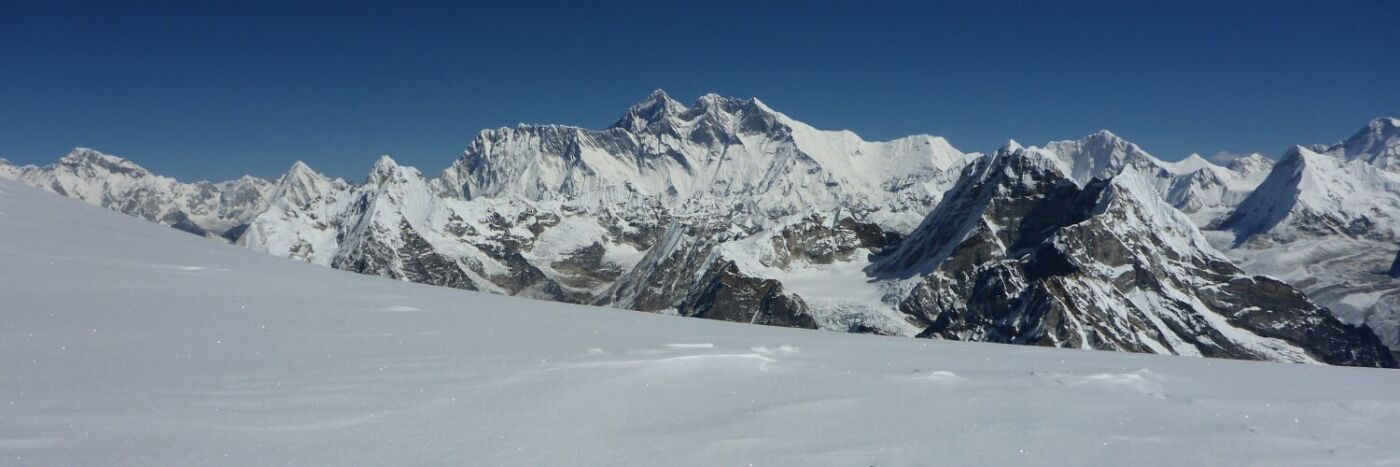
- Take in an extraordinary panorama of Everest, Kangchenjunga, Lhotse, Makalu and Cho Oyu
- Receive a complimentary Water-to-Go bottle (or new filter for returning trekkers) to help reduce single-use plastic.
Overview
Mera Peak is the highest trekking summit in Nepal at 6476m – and one of the most rewarding climbs in the Himalaya. This journey takes you from the bustle of Kathmandu to the quiet, high valleys of the Inkhu Khola, across ancient glacial landscapes and onto the broad snow slopes leading towards the summit. It’s a challenge shaped by altitude, endurance and technique, supported by expert Sherpa guidance, Jo Bradshaw’s high-altitude experience, and some of the most extraordinary scenery on earth.
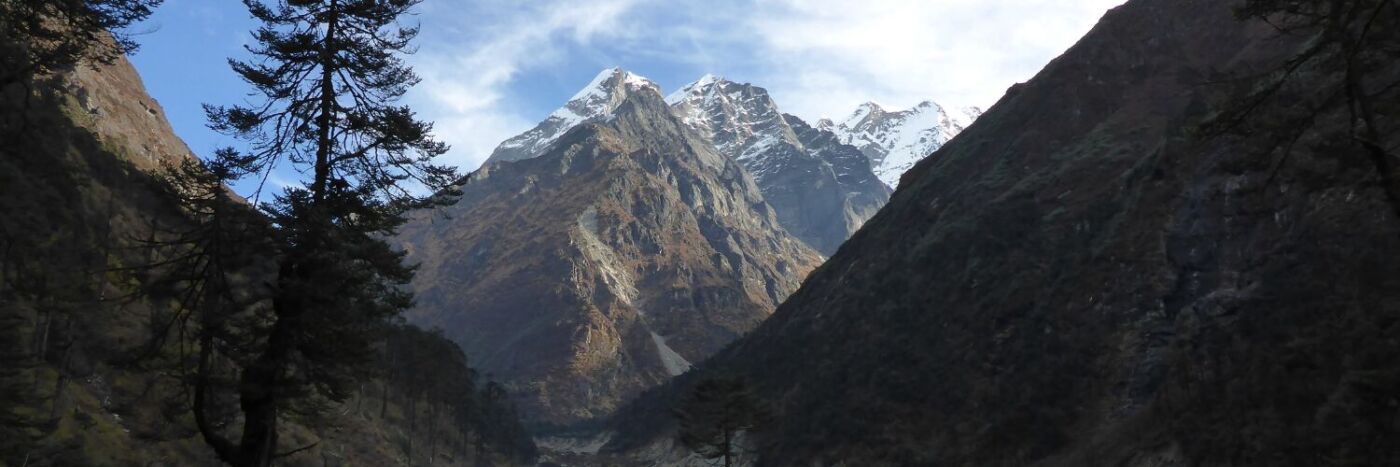
Your adventure begins in Kathmandu with final preparations before travelling to Manthali for the short flight to Lukla. From here, the trail leads through rhododendron forests, hillside hamlets, yak pastures and deep river valleys as you trek steadily towards the towering south face of Mera Peak. Each day takes you higher into the dramatic Inkhu Valley, where the landscape evolves from forest to alpine terrain to glacial wilderness.
Day 1: Arrival and transfer to hotel (20mins approx)
Welcome to Nepal. Meet and greet at the airport. Your Trek Guide will be waiting for you inside the airport arrival hall holding an ‘Adventurous Ewe’ board.
Private transfer through the maze of Kathmandu to your hotel, the famed Kathmandu Guest House. Centrally located in the eclectic and cosmopolitan tourist hub of Thamel. After settling in, your Trek Guide will hold a pre-trek briefing. Afterwards, he/she will also take you on a short orientation walk around the hotel surrounds for 30mins approx.
Included
Transfer: group transfer at nominated time
Accommodation: Kathmandu Guest House (3*) – deluxe room twin share
Meals: Welcome dinner
Day 2: Drive to Manthali (Ramechhap)
After breakfast, you leave Kathmandu and travel east towards Manthali in the Ramechhap district — the regional airport where most Lukla flights depart during peak trekking season (March–May and October–November). The journey takes around 6 – 7 hours, following a scenic mix of winding roads, river valleys and rural hillside settlements that ease you gently into life beyond the capital.
After a long journey to Nepal, this day is deliberately designed to help you prepare for the days ahead. Reaching Manthali in daylight gives you time to rest, rehydrate and reset before flying into the mountains — all essential for maximising your trekking experience as you begin your ascent into high altitude terrain.
You’ll stay in a simple but comfortable resort close to the airport, settle in with a warm meal and get a good night’s sleep before your early flight to Lukla tomorrow morning. It’s the ideal way to start the expedition feeling fresh, focused and ready for the trail ahead.
(If your Lukla flight is scheduled to depart from Kathmandu instead, you’ll enjoy an extra night in the city with time to explore or pick up any final gear.)
Included
Transfer: Private transfer
Accommodation: Freedom Resort, twin-share room
Meals: Breakfast, Lunch, Dinner
Fly to Lukla and Trek to Puyan (2,820m)
It’s an early start as you take a short transfer to Manthali Airport for the scenic morning flight to Lukla — the gateway to the legendary Sherpa region. The 15–20 minute flight is a spectacular intro to the Himalaya, with steep hillsides, deep valleys and distant snowy summits unfolding beneath you.
On arrival in Lukla (2,800m), you meet your wonderful Sherpa team and begin the trek towards Puyan. The trail descends steeply towards the Dudh Koshi, the powerful river fed by the glaciers of Everest. You’ll share the path with local traders, porters and other trekkers, offering your first real glimpse into daily life in the Khumbu.
After reaching Surke (approx. 2 hours), the route climbs out of the valley, rewarding your efforts with sweeping views — Cho Oyu rising above you, the river canyon dropping away below. A further 2 hours brings you to Paknepani for lunch.
The final stretch to Puyan takes around 2 hours, winding through pockets of rhododendron forest and small hillside settlements. The Dudh Koshi remains visible in the distance, carving its way through the valley below. Weather permitting, this is also where you may catch your very first views of Everest, Lhotse and Nuptse.
Tonight’s stop is the quiet village of Puyan, a gentle and welcoming place to settle into the rhythm of mountain trekking.
Activity
Trekking: Approx. 6 hours
Included
Transfer: Private transfer
Domestic flight: Manthali to Lukla
Accommodation: Basic teahouse in Puyan (twin-share)
Meals: Breakfast, Lunch, Dinner
Trek to Pangum (2,850m)
Your day begins with a gentle 1.5-hour climb towards the Khari La Pass (2,860m). The trail winds through dense forest, where occasional clearings reveal distant snow-covered peaks rising above the clouds. With Pangum visible ahead, the landscape feels increasingly remote and alpine.
After reaching the pass, a gradual hour-long descent leads to your lunch stop — a peaceful break surrounded by forest and hillsides. The afternoon continues with a steady 2.5-hour climb, bringing you into the traditional village of Pangum. This is your final Sherpa settlement before entering the wilder, quieter valleys beyond.
Activity
Trekking: Approx. 6 hours
Included
Accommodation: Basic teahouse in Pangum (twin-share)
Meals: Breakfast, Lunch, Dinner
Trek to Ningsow (3,100m)
This morning begins with a short climb to the Pangum La Pass (3,010m), where you cross into the quiet and dramatic Inkhu Valley. The landscape shifts immediately — wilder, more remote, and with a real sense of stepping deeper into the Himalaya.
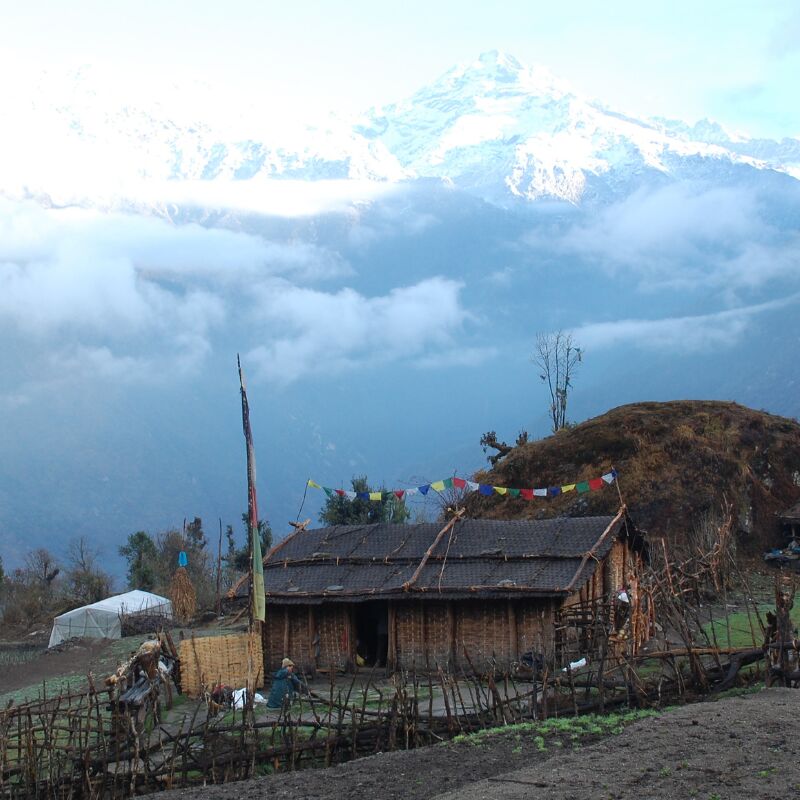
You pass through the small village of Bhusme (approx. 1 hour), the last permanent settlement you’ll encounter before the higher valleys. From here, a steady 3-hour trek leads you through forested hillsides and open clearings towards Ningsow, a tiny hamlet marked by a cluster of shepherds’ huts in a peaceful forest clearing.
It’s a simple, atmospheric overnight stop that signals your arrival into the more remote reaches of the expedition.
Activity
Trekking: Approx. 6 hours
Included
Accommodation: Basic teahouse in Ningsow (twin-share)
Meals: Breakfast, Lunch, Dinner
Trek to Chhetra Thanga (3,300m)
Today is a full and rewarding day on the trail as you continue deeper into the Inkhu Khola Valley. The route winds along gentle spurs on the western side of the valley, offering occasional glimpses of the river far below as it threads its way through this impressive glacial landscape.
The path leads through quiet stretches of forest and open sections with wide views across the valley. The terrain has a wonderfully remote feel, and you’ll notice the environment becoming more rugged and alpine as the altitude gradually increases. Steady, consistent trekking brings you to the small settlement of Chhetra Thanga, your peaceful home for the night.
Activity
Trekking: Approx. 7 hours
Included
Accommodation: Basic teahouse in Chhetra Thanga (twin-share)
Meals: Breakfast, Lunch, Dinner
Trek to Kothe (3,691m)
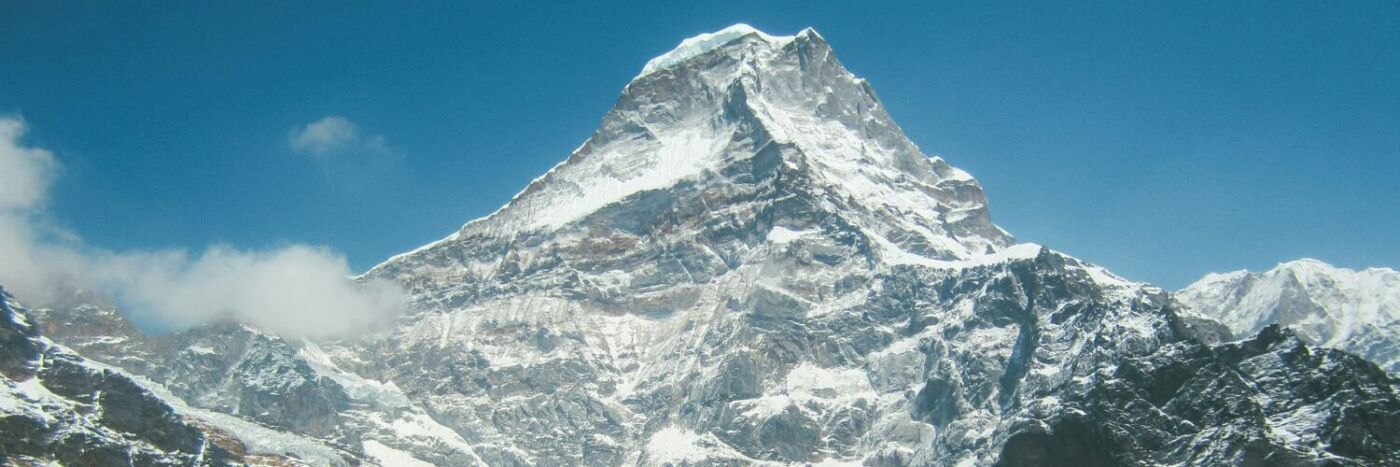
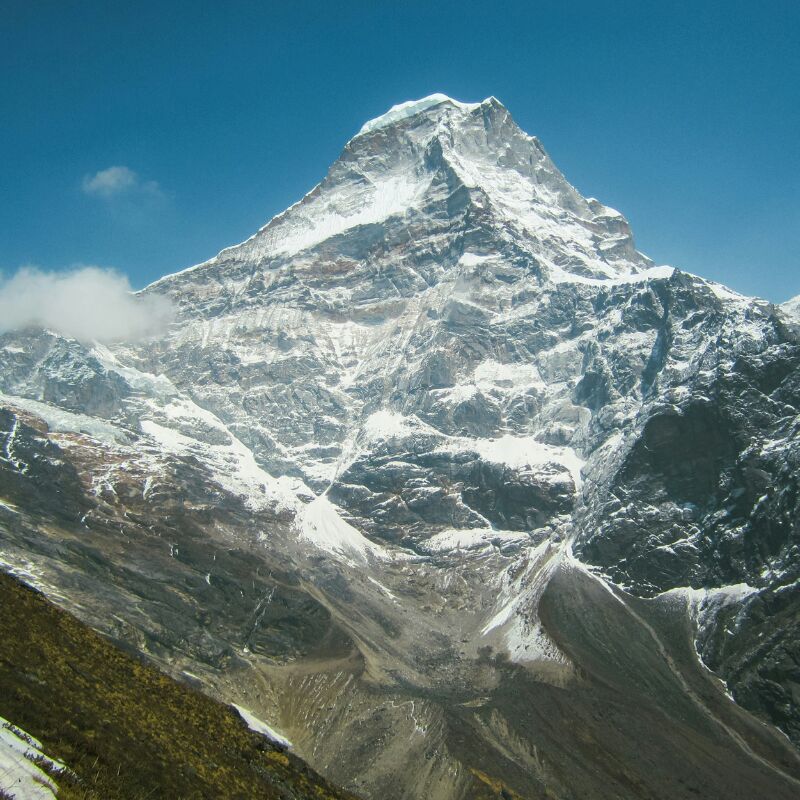
After breakfast, you begin with a short but steep 500m climb that rewards you with striking contrasts: rolling foothills stretching to the south and, to the north, your first full view of Mera Peak’s dramatic southwest face. It’s an exciting moment — the mountain begins to feel close now.
The trail then leads through beautiful, untouched forest filled with tall pines, mosses, lichens and rhododendron. It’s a peaceful section of the route, with soft forest light and the steady sound of the river far below. A gentle descent brings you to the upper Inkhu Khola and the small collection of huts and summer yak pastures that mark Kothe.
This quiet riverside settlement is your stop for the night and a welcome chance to rest before the altitude begins to rise more sharply.
Activity
Trekking: Approx. 5 hours
Included
Accommodation: Basic teahouse in Kothe (twin-share)
Meals: Breakfast, Lunch, Dinner
Trek to Thangnak (4,200m)
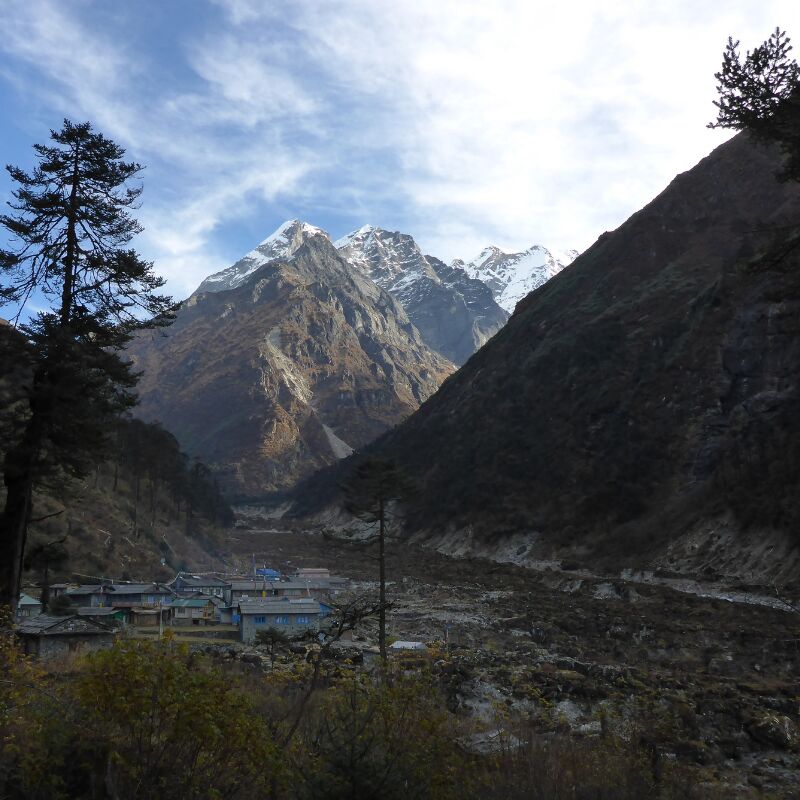
Today the landscape shifts noticeably as you leave the forests behind and enter a higher, more open valley. Peak 43 rises ahead, marking the head of the Inkhu Valley, while the dark west face of Mera comes into view on your right — a dramatic reminder of the journey still to come.
It’s a shorter walking day, with around four hours on the trail. The route follows the valley floor, gradually gaining altitude as the scenery becomes increasingly glacial and rugged. You’ll stop for lunch with Mera Peak towering above — a powerful moment of anticipation as the mountain begins to dominate the skyline.
By early afternoon, you arrive in Thangnak, a small settlement surrounded by high peaks and open terrain. It’s an important acclimatisation stop and your first real taste of the high-altitude world ahead.
Activity
Trekking: Approx. 4 hours
Included
Accommodation: Basic teahouse in Thangnak (twin-share)
Meals: Breakfast, Lunch, Dinner
Acclimatisation Walk in Thangnak (4,200m)
Today is the first of three planned acclimatisation days designed to help your body adjust safely to the increasing altitude. You’ll take a steady 3-hour hike to nearby glaciers, reaching elevations of up to 5000m. The pace is relaxed and purposeful, giving you time to get used to the thinner air while enjoying incredible views of the surrounding ice fields and high peaks.
The afternoon is free to rest, rehydrate and prepare for the days ahead — a vital part of ensuring a safe and successful ascent.
Activity
Trekking: Approx. 3 hours
Included
Accommodation: Basic teahouse in Thangnak (twin-share)
Meals: Breakfast, Lunch, Dinner
Trek to Khare (4,900m)
Today you leave Thangnak and head east across the broad moraine of the Dig Glacier. The climb is gradual but steady, and you’ll feel the increasing altitude as you make your way towards the open pastures of Dig Kharka. After a couple of hours the terrain levels out, giving you a chance to catch your breath and take in the glacial surroundings.
From Dig Kharka, the trail crosses a small stream before climbing for around an hour towards Khare. As the valley curves north, the views open dramatically — and you’re rewarded with your first full sight of the impressive north face of Mera Peak. It’s a powerful moment and a clear sign that you’re entering the heart of the expedition.
Khare, your base for the next two nights, is a small, atmospheric settlement surrounded by towering peaks and the sweeping lower slopes of the mountain.
Activity
Trekking: Approx. 5 hours
Included
Accommodation: Basic teahouse in Khare (twin-share)
Meals: Breakfast, Lunch, Dinner
Acclimatisation and Training at Mera La (5,415m)
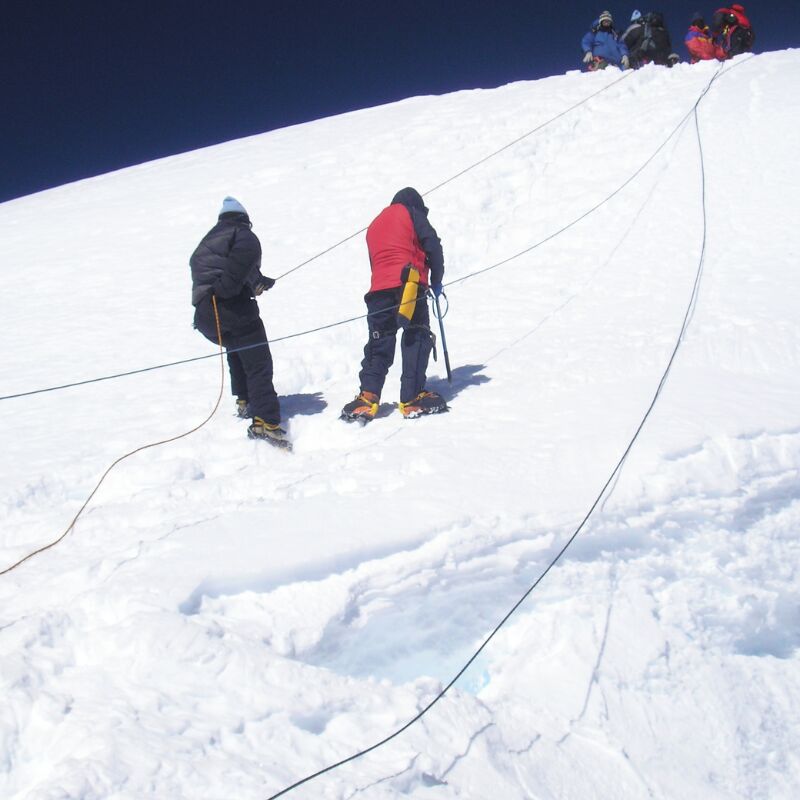
Today is your second acclimatisation day and an important part of preparing for the summit. You’ll leave Khare and make your way onto the moraine and scree slopes at the base of the Mera Glacier, using the morning to familiarise yourself with high-altitude climbing gear and essential glacier travel techniques under the guidance of your Sherpa team.
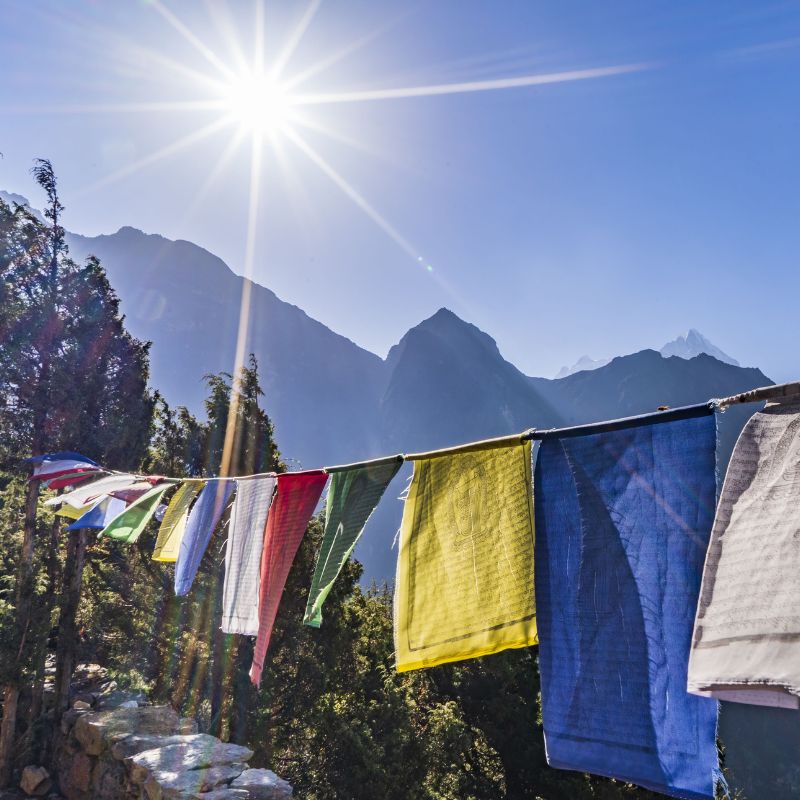
The route climbs steadily towards the Mera La, weaving between the lower crevasses on the glacier’s eastern side. After about half an hour the slope eases, opening onto a wide plateau that leads gradually up to the pass. A final push brings you to the prayer flags marking the Mera La at 5415m — a spectacular high point with clear views of the route you will follow towards the summit in the days ahead.
After taking in the scenery and reviewing the next stages of the climb, you descend back to Khare for a restful afternoon and final preparations before moving higher.
Activity
Trekking: Approx. 4–5 hours
Included
Accommodation: Basic teahouse in Khare (twin-share)
Meals: Breakfast, Lunch, Dinner
Trek to Base Camp (5,100m)
Today you move higher into the high-altitude world of Mera Peak. From Khare, you climb steadily with your high-altitude support team towards the foot of the glacier, following a well-paced route designed to support safe acclimatisation. While some expeditions push directly to High Camp, this staged ascent makes a significant difference to your comfort and safety — and greatly improves your chances of a successful summit.
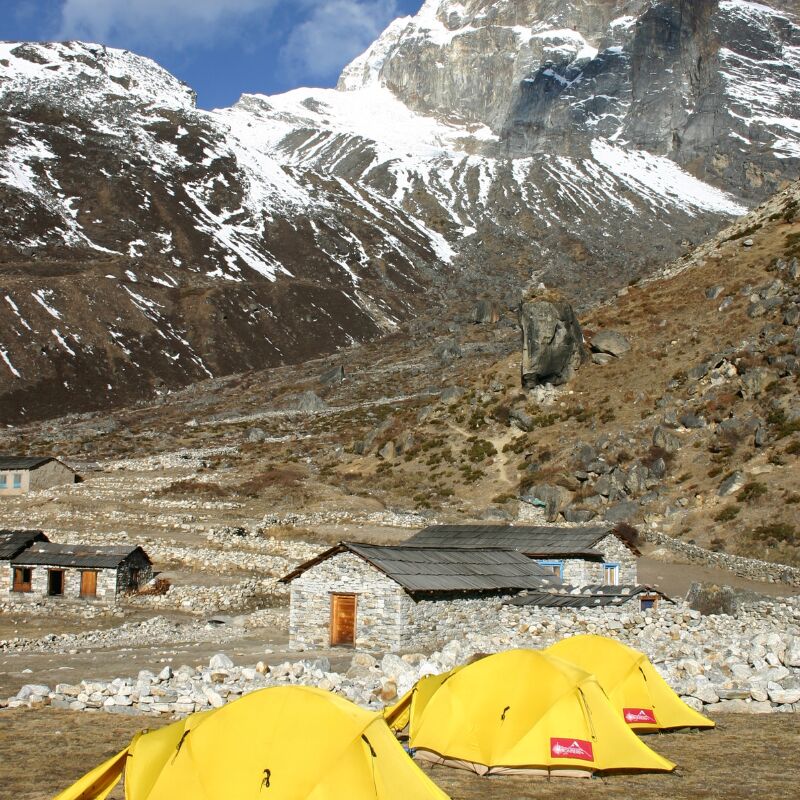
Your Sherpa team establishes Base Camp at around 5100m, a stunning setting surrounded by towering ridgelines and the vast white slopes of the upper mountain. From here, the summit team continues climbing towards the High Camp plateau, gaining more altitude while taking time to absorb the remarkable surroundings. The views towards Everest, Makalu, Lhotse and Kangchenjunga are a powerful reminder of where you are in the world.
By late afternoon, you return to Base Camp for your first night above 5000m — a key step in your acclimatisation and an exciting milestone in the expedition.
Activity
Trekking: Approx. 7.5 hours
Included
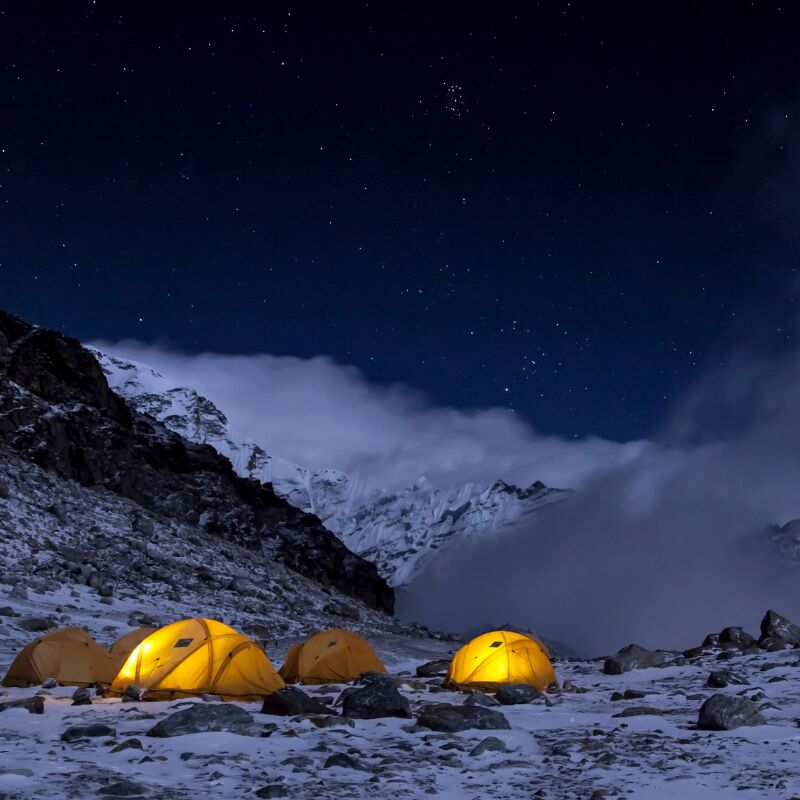
Accommodation: Camping (twin-share tent)
Meals: Breakfast, Lunch, Dinner
Trek to High Camp (5800m)
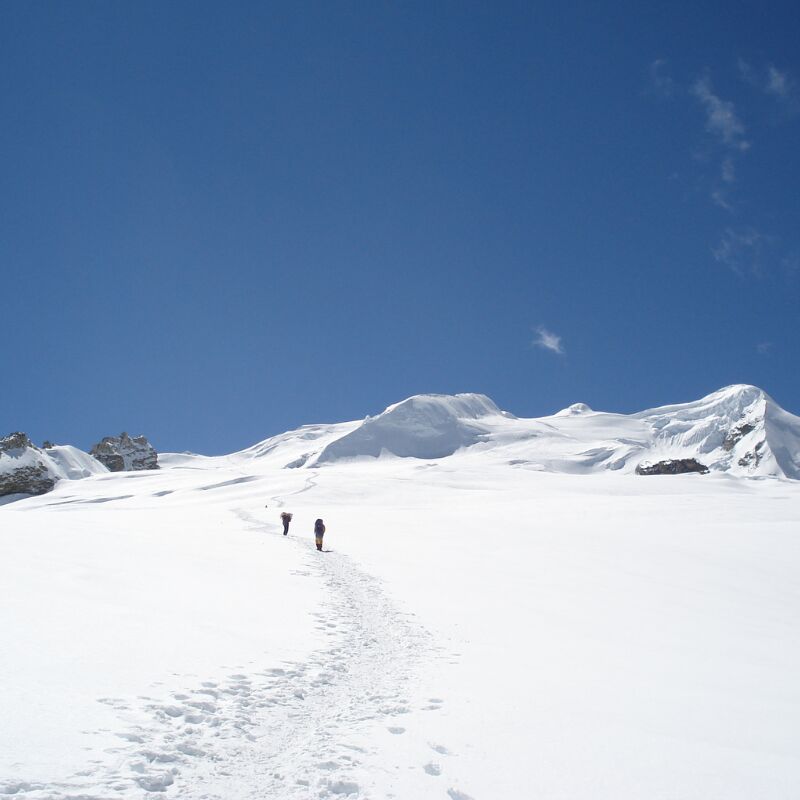
This morning you follow the now-familiar route back onto the glacier, ascending steadily towards High Camp. After yesterday’s climb, the terrain feels more familiar and the gradual rise in altitude makes today’s ascent feel noticeably smoother.
Your group is now streamlined to the summit team, supported by a high-altitude cook and porters who will later descend to Khare to wait for your return. The climb takes around three hours, bringing you onto a dramatic platform of ice and rock with sweeping views across the Himalaya.
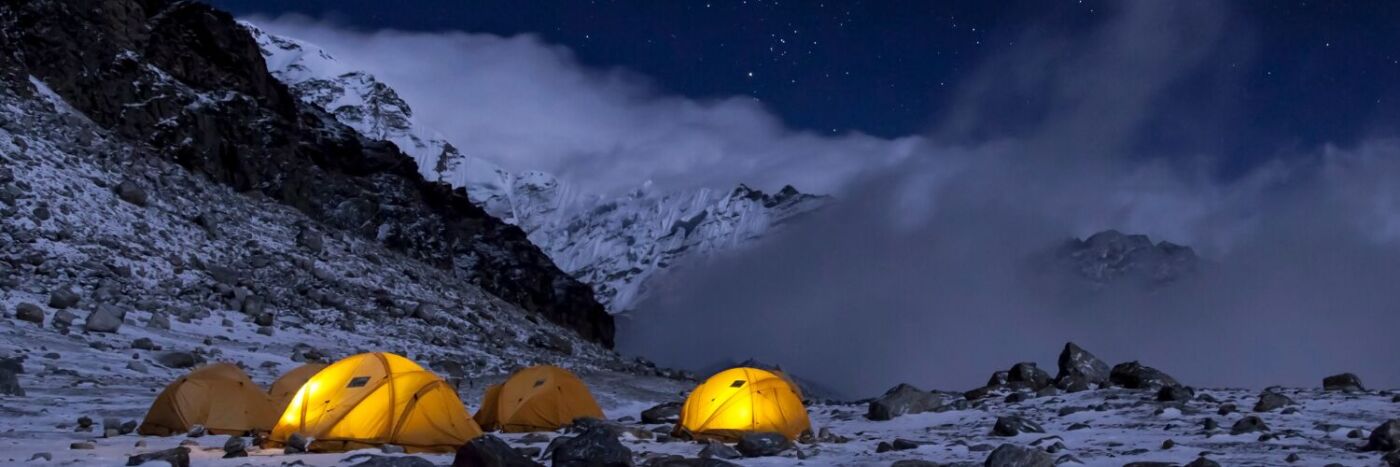
High Camp sits on the sheltered side of a rocky outcrop beneath the upper glacier — a striking, minimalist campsite that truly feels like the high Himalaya. You arrive by mid-afternoon with plenty of time to rest, hydrate and eat well in preparation for tomorrow’s pre-dawn summit push.
Activity
Trekking: Approx. 3 hours
Included
Accommodation: Camping (twin-share tent)
Meals: Breakfast, Lunch, Dinner
Summit Mera Peak (6476m) and descent to Khare (4900m)
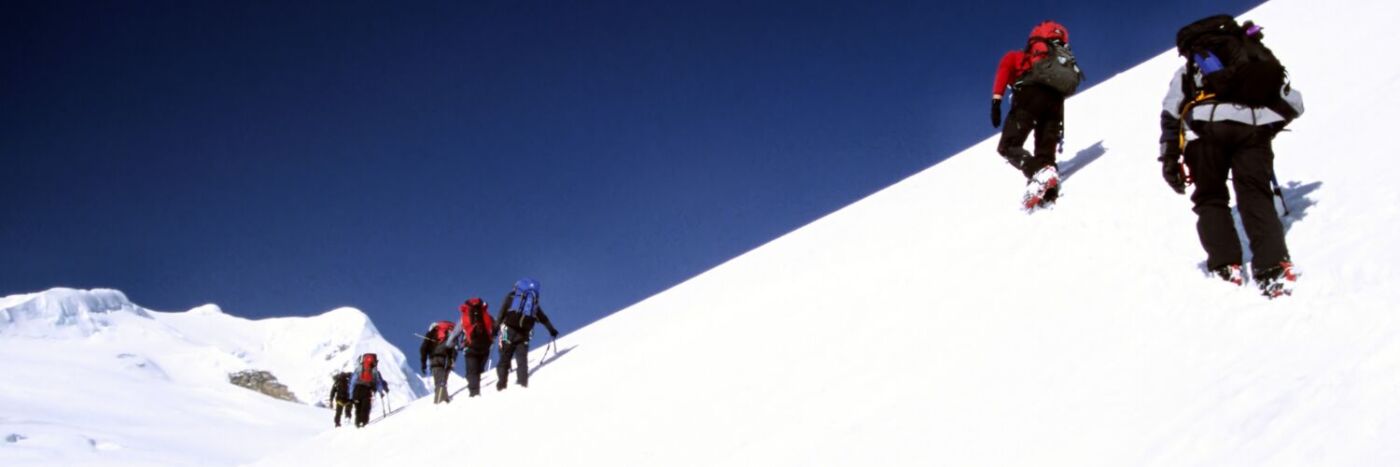
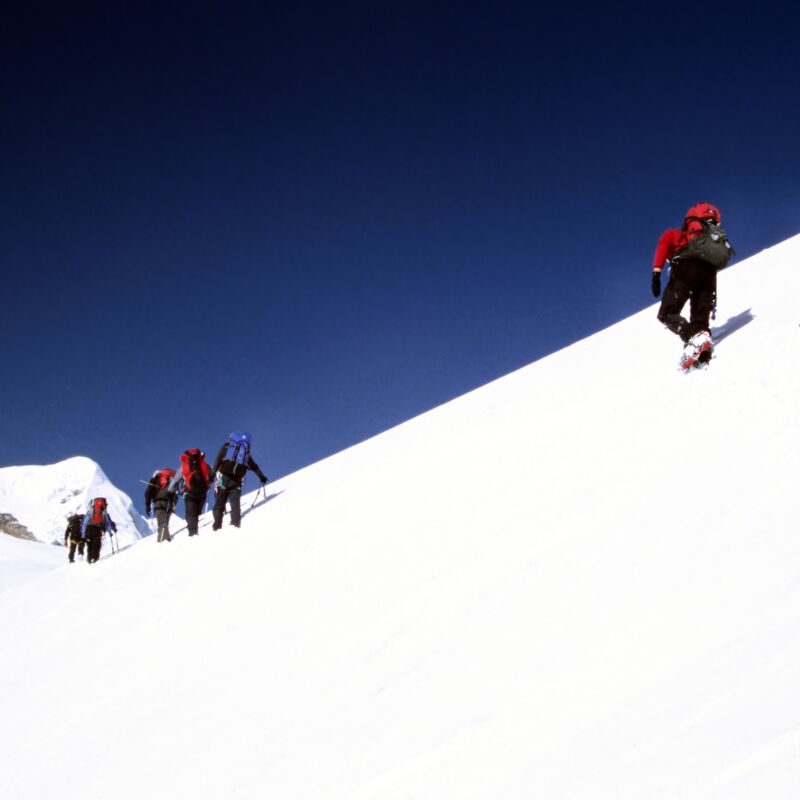
Summit day begins long before dawn. You leave High Camp around 2am, stepping out into the cold, clear darkness with headlamps cutting across the snow. Moving roped together, you follow the gentle arc of the glacier under a sky filled with Himalayan starlight — a surreal and unforgettable start to the climb.
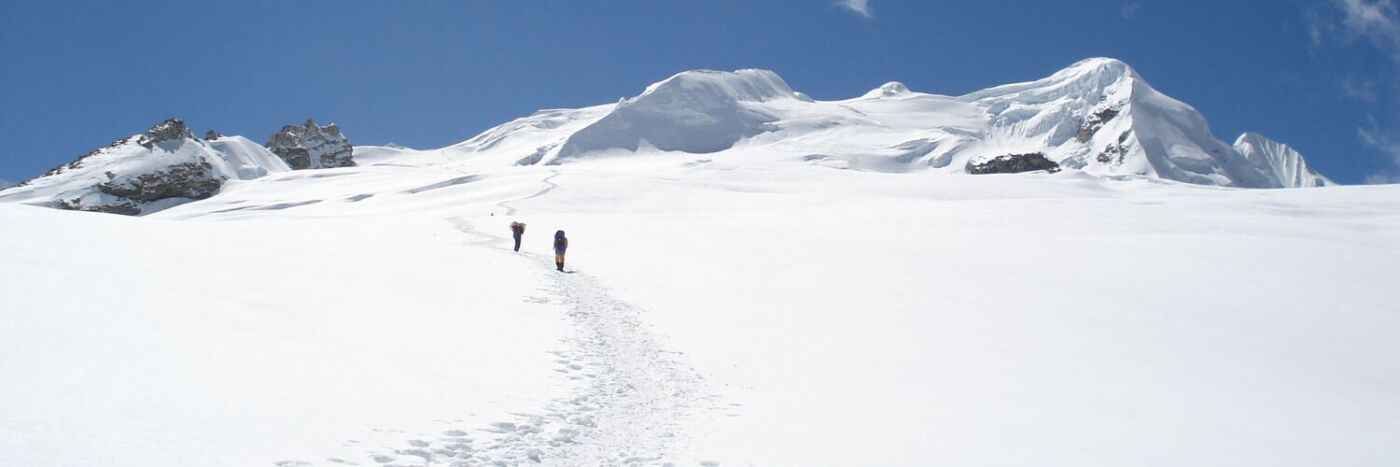
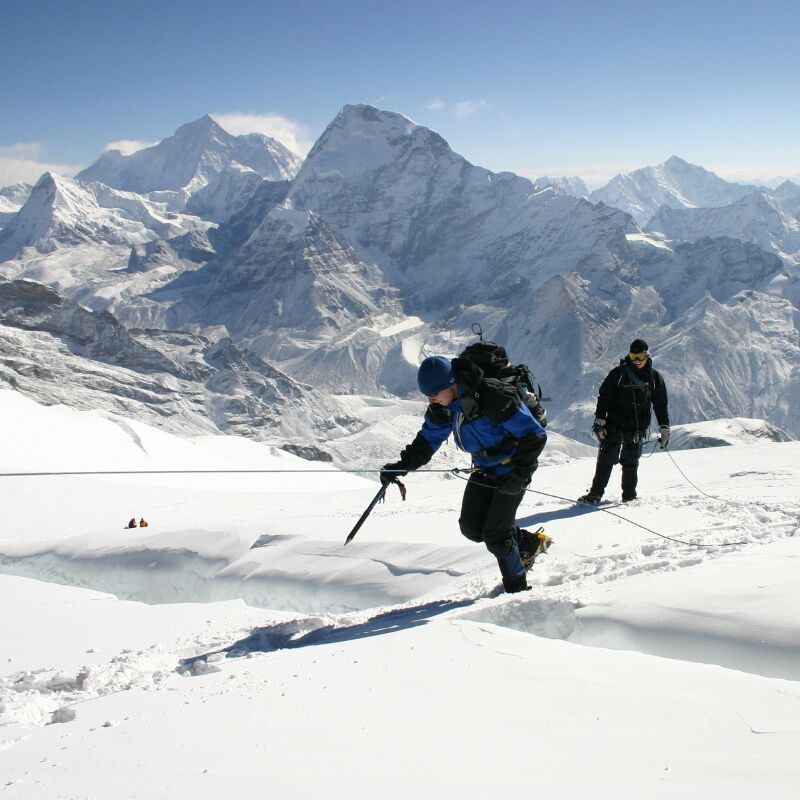
As the horizon brightens, you gain the first of several false summits. The scale of the mountains around you becomes more dramatic with every step. A few crevasses mark the way towards the upper slopes, before the gradient steepens for the final push to the summit.
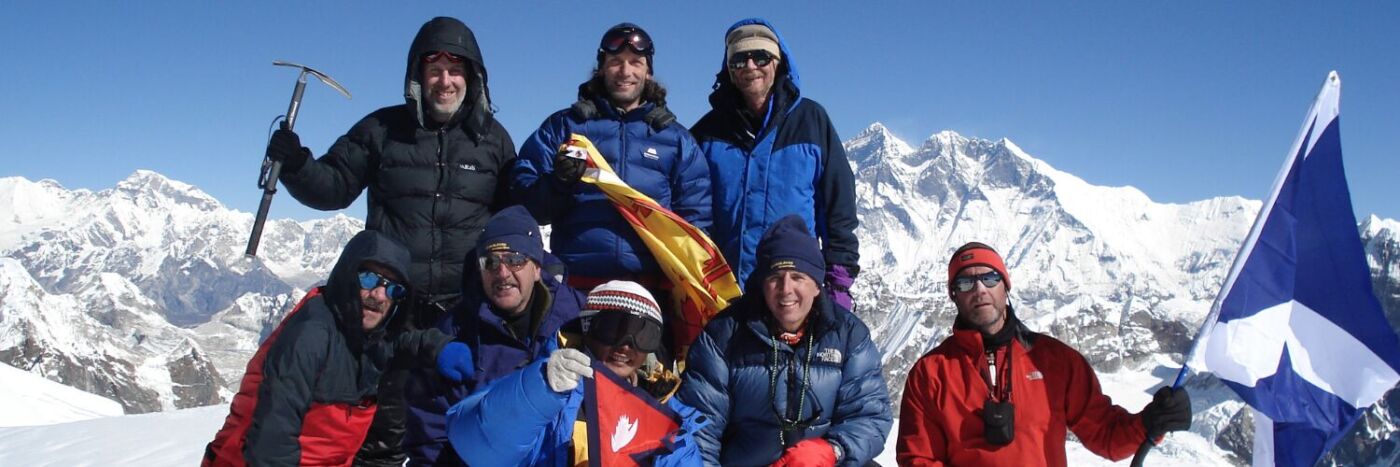
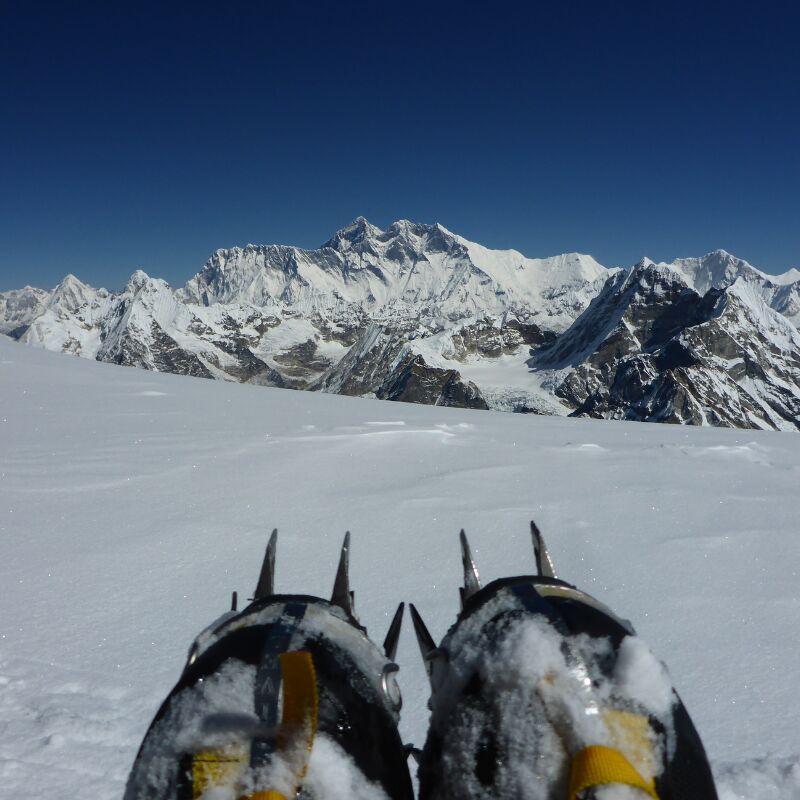
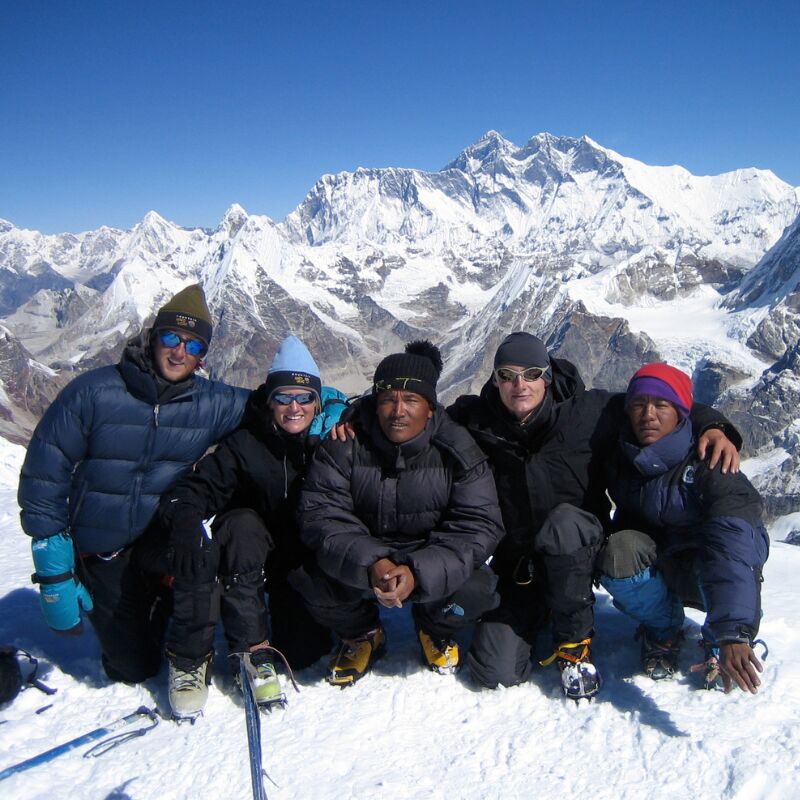
After hours of steady, determined climbing, you reach the summit of Mera Peak at 6476m. The reward is immense: one of the greatest panoramas in the Himalaya, with Everest, Lhotse, Makalu, Kangchenjunga and Cho Oyu rising across the horizon. It’s a moment that stays with you.
After taking in the views and celebrating with your team, you retrace your route back to High Camp and continue your long descent to Khare, where a warm meal and a real bed await after this huge milestone.
Activity
Trekking: Approx. 10–12 hours
Included
Accommodation: Basic teahouse in Khare (twin-share) 4900m
Meals: Breakfast, Lunch, Dinner
Contingency Day
This additional day is built into the itinerary to support the success and safety of your climb. It provides flexibility for weather, mountain conditions or acclimatisation needs — all key factors on a high-altitude expedition. If conditions are favourable and the team is well-acclimatised, this day can also be used for extra rest in Khare before beginning the journey back down the valley.
Included
Accommodation: Basic teahouse or camping (twin-share)
Meals: Breakfast, Lunch, Dinner
Return to Kothe (3691m)
With the summit behind you, today’s descent feels noticeably easier. Distances seem shorter, the air grows thicker and each step brings renewed energy. You retrace your path through the high valley, passing familiar landmarks around Thangnak before continuing down towards the peaceful yak pastures of Kothe.
It’s a rewarding day on the trail — a chance to reflect on your summit achievement while enjoying the steady rhythm of downhill walking.
Activity
Trekking: Approx. 6 hours
Included
Accommodation: Basic teahouse in Kothe (twin-share)
Meals: Breakfast, Lunch, Dinner
Trek to Thulikharka (4320m)
Although you’re on the return journey, today still delivers a solid dose of uphill trekking. The day begins with a descent along a rocky trail into the Hinku Valley before the route climbs steeply back into the forest. As you gain altitude, the rhododendron trees thin out and alpine shrubs take over, revealing wider views across the valley.
Looking back, you’re treated to an impressive sight of Mera Peak’s south face — a powerful reminder of how far you’ve come. The trail narrows and steepens as you continue through the forest, before opening suddenly into a landscape that feels almost Highland-like in its wide, rolling terrain.
A short traverse along the hillside brings you to the small settlement of Thulikharka, perched high above the valley and offering a peaceful, scenic stop for the night.
Activity
Trekking: Approx. 6 hours
Included
Accommodation: Basic teahouse in Thulikharka (twin-share)
Meals: Breakfast, Lunch, Dinner
Trek to Lukla via Zatrwa La Pass (2840m)
Your final trekking day is a memorable one. The trail begins with a steady climb of around 300m to reach the Zatrwa La Pass (4540m), the last major high point of the expedition. From the top, you’re rewarded with sweeping views stretching south across ridges, valleys and distant foothills — a fitting finale to your time in the high mountains.
The descent from the pass is on a well-made trail, and although the slopes are steep, the path is clear and well-defined. As you drop lower, the landscape softens and woodland returns, guiding you into the final stretch towards Lukla. By late afternoon you arrive in the lively trekking hub, where a warm meal and a celebratory atmosphere await.
Activity
Trekking: Approx. 8 hours
Included
Accommodation: Basic teahouse in Lukla (twin-share)
Meals: Breakfast, Lunch, Dinner
Fly to Manthali and Drive to Kathmandu
Your day begins with an early morning flight from Lukla back to Manthali, offering one last unforgettable glimpse of the Himalayan foothills from the air. Once you land, a private transfer takes you on the six-hour drive to Kathmandu, following the familiar winding valleys and hillside roads that lead back to the capital.
Returning to Kathmandu feels both grounding and celebratory after days at high altitude. Settle into your hotel, take a well-earned hot shower and enjoy some downtime before gathering with your teammates for a final celebration meal. It’s the perfect moment to reflect, reminisce and share stories from your climb — from glacier training and summit day to the hospitality and strength of your Sherpa team who helped make the journey possible.
Included
Transfer: Private transfer
Domestic flight: Lukla to Manthali
Accommodation: Kathmandu Guest House (3*) – deluxe room twin share
Meals: Breakfast, Lunch, Dinner
Farewell Nepal
Your Himalayan journey comes to an end today. After breakfast, you transfer to Kathmandu Airport at the designated time for your group flight. You leave Nepal with an immense sense of pride, a deeper appreciation for the mountains, and memories that will stay with you long after the trek is over.
Included
Transfer: Hotel to Kathmandu Airport (designated group flight time)
Meals: Breakfast only
Climbing Mera Peak is far more than reaching the highest trekking summit in Nepal — it’s a journey that supports remote mountain communities, protects fragile high-altitude environments, and connects you with the people who call these valleys home.
This route carries you deep into the lesser-visited Inkhu Valley, where small family-run teahouses, yak herders’ settlements and high-altitude villages remain central to the rhythm of life. Your support here matters. Tourism provides vital income for guides, porters, lodge owners and farmers in a region where opportunities are limited, and every step you take helps sustain local livelihoods.
The mountain lies close to the boundary of the Makalu Barun National Park, a vast protected area known for its rare wildlife, pristine trails and rugged wilderness. Your park entry fees contribute directly to conservation projects, trail maintenance, waste management and the protection of delicate alpine ecosystems.
By choosing to climb with Adventurous Ewe, you minimise your impact while maximising your positive contribution. Our small-group approach reduces pressure on trails and teahouses. Every trekker receives a Water-to-Go bottle to help cut single-use plastic in Nepal. We work exclusively with experienced Sherpa teams who are paid fairly, insured properly and trained in responsible mountain travel. And our carefully paced itinerary — with acclimatisation days and a staged ascent — supports safer travel and a deeper connection with the landscape.
This is adventure with purpose: a chance to stand on a 6,476m Himalayan summit, while supporting Nepal’s commitment to community-led tourism and environmental stewardship.
Every expedition we operate is built in line with our Travelife Partner certification, reflecting our ongoing commitment to responsible travel and continuous improvement in sustainability across all our operations.
Once you’ve booked your Mera Peak Expedition, all your trip details will be sent to you via our free mobile travel app, Vamoos.
You’ll have everything you need at your fingertips – your full itinerary, kit list, “know before you go” info, weather forecasts, live updates, contact details and even a trip countdown – all available 24/7 on your phone.
It’s simple, convenient and paper-free, helping us reduce waste and keep your adventure that little bit greener. No bulky folders, no missing pages – just everything you need for your journey in Nepal. A’ppy days.
As a small family business, we take great pride in offering a personal, professional and friendly service for your Mera Peak Expedition. Every adventurer joins this journey with different motivations, experience levels and goals — and we’re here to support you every step of the way, from the moment you join the flock to long after you’ve returned home.
Our close-knit team brings decades of experience in leading, planning and filming high-altitude expeditions around the world. With first-hand knowledge of Nepal and long term partnerships with our Sherpa team in the Khumbu and Inkhu valleys, you’ll receive accurate, up-to-date and honest advice as you prepare for your climb.
Whether you have questions about kit, training, altitude, flights or logistics, you’ll always receive tailored guidance from people who genuinely care about your experience. Your preparation matters — and we’re here to help you feel ready, confident and excited for the adventure ahead.
Flights
Flights are not included in your Mera Peak Expedition, giving you the flexibility to travel from your nearest airport, use frequent flyer points, or extend your stay in Nepal if you wish. Once you sign up, we’ll provide recommended flight options into Tribhuvan International Airport (Kathmandu), typically via major hubs in the Middle East or Asia.
A single group airport transfer is included for the designated arrival and departure times, ensuring a smooth and easy start to your adventure. If you choose different flights, we can help arrange a private transfer at an additional cost, or you’re welcome to make your own arrangements.
Internal flights in Nepal
Travel into the high and remote regions of the Himalaya — including the gateway to Mera Peak — relies on internal flights between Manthali Airport (Ramechhap) and Lukla Airport. Mountain weather can be unpredictable, and flying conditions in the Himalaya are more complex than in lowland regions. Nepal’s aviation standards differ from those in Western countries, and all Nepali airlines currently appear on the European Commission’s list of carriers not permitted to operate within EU airspace.
Adventurous Ewe takes this seriously. In 2017, UK tour operators commissioned an independent air-safety audit of Nepal’s domestic airlines. From this, we fly only with carriers approved through that audit: Yeti Airlines, Tara Air, Buddha Air and Summit Air.
Both Tara Air and Yeti Airlines have also passed the IATA Standard Safety Assessment (ISSA) for operators of smaller aircraft — an internationally recognised safety benchmark.
We continue to work with other operators to monitor aviation safety in Nepal and always act with duty of care at the forefront of our decisions.
Weather-related delays
Poor weather can occasionally cause delays or cancellations on internal flights. If this happens at the start of your trip, you’ll spend an extra night near the airport (which may not be the same hotel as the group). On most expeditions, the itinerary has enough flexibility to absorb one or two days of delay. Should cancellations continue, an alternative trek will be offered.
Helicopters can sometimes fly when fixed-wing aircraft cannot. If charter helicopters are available, your group may be offered this option. The cost is shared between those choosing to fly.
Trip contingencies
Your itinerary includes one contingency day during your expedition to allow for potential delays on the return flight from Lukla. If helicopters are able to operate when fixed-wing flights are grounded, we may use them on a case-by-case basis to help you make your international flight.
In the extremely unlikely event that cancellations prevent you from catching your homeward international flight, you will be responsible for rebooking your onward travel and covering associated costs. We strongly recommend suitable travel insurance that covers delays and missed international connections.
Road conditions and driving standards in Nepal differ from those in the UK, Australia, Canada, USA, and travel between regions can sometimes feel slower or more rugged than expected. To ensure your comfort and safety, we always use reputable drivers and the highest standard of vehicles available for our transfers.
Seatbelts are not legally required in the rear seats of many Nepali vehicles. While we do our best to arrange vehicles fitted with rear seatbelts, this cannot always be guaranteed. If at any point you have concerns about the vehicle or driving standards, please speak to your Leader straight away — your safety and peace of mind are our priority.
Road infrastructure across Nepal is improving but still developing. Ongoing construction projects, busy city routes, and occasional demonstrations or bandhs (strikes) can cause unexpected delays. Major roadworks are currently taking place in and around Kathmandu, so traffic, uneven road surfaces and dust are all common features of road travel.
These transfers, however, are an integral part of the journey — offering a glimpse into everyday Nepali life, landscapes and local rhythms before you head deeper into the mountains.
To enter Nepal, you’ll need a valid passport and visa. Please ensure your passport meets the following requirements:
-
Passport Validity: Your passport must be valid for at least 6 months from your date of arrival in Nepal.
-
Blank Pages: It must have at least one blank page for your visa stamp.
Important Notes:
-
Carry a printed copy of your visa confirmation if you apply online.
-
Always check the latest guidance before travel as requirements may change.
For up-to-date official advice, visit:
-
UK travellers: gov.uk Nepal Entry Requirements
-
Australian travellers: Smartraveller Nepal
All foreign nationals, except Indians, are required to have a valid visa to enter Nepal. A valid Nepalese visa, which can be obtained from Nepalese diplomatic missions outside Nepal or on arrival in-country, is also required to enter Nepal. Information regarding Nepalese visa and immigration can be found on the Government of Nepal’s website, www.nepalimmigration.gov.np. Please note, requirements often change and it is your responsibility to obtain any required visas for this trip. Therefore, we recommend that you check with the nearest embassy or consulate of your chosen destination(s), including any countries you may be transiting or transferring through.
Some local governments provide guidance on what visas their citizens need. To help, we’ve gathered a selection of useful links below.
- Australia: www.smartraveller.gov.au/destinations/asia/nepal
- Canada: www.travel.gc.ca/destinations/nepal
- United Kingdom: www.gov.uk/foreign-travel-advice/nepal/entry-requirements
- USA: www.travel.state.gov/content/travel/en/international-travel/International-Travel-Country-Information-Pages/Nepal.html
You can obtain your visa in advance or on entry. If possible, apply in advance as queues on arrival can be very long. Please note, the Immigration Department of Nepal has suspended visas on arrival for certain nationalities – please check if this applies to you with your nearest embassy or consulate .
When you arrive at Tribhuvan International Airport in Kathmandu, there will be three lines. If you have already secured you visa, go straight to the Immigration line. If not:
- Fill in a tourist visa form at the electronic kiosks. After inserting your passport, the machine will automatically fill out an application form, take an electronic photograph of you and print a paper slip. If the machine won’t read your passport, complete the details manually using the touchscreen. We recommend taking a passport photo with you just in case.
- Proceed to the visa fees collection counter and pay the visa fee (in cash, if possible). Make sure to keep the receipt.
- Go to the relevant immigration desk and present your tourist visa form, payment receipt and passport to obtain your 15-, 30- or 90-day visa stamp. Please check you have been given the correct visa duration.
Travel Insurance & Global Rescue
Travel insurance is a vital part of your Mera Peak Climb – and it’s compulsory for all participants. Your policy must include comprehensive cover for:
-
The full value of your trip
-
Medical expenses (including emergency evacuation and repatriation)
-
All activities undertaken on the trek including maximum altitude of 6476m
-
Personal liability
-
Trip cancellation and curtailment
-
Loss of luggage and personal belongings and flight delays
-
Pandemic-related travel disruptions
For UK residents, we’ve partnered with Campbell Irvine Direct, a specialist insurance broker, to offer tailored travel insurance. If you’d like a quote for cover that aligns with our expedition requirements, visit here.
Important:
We suggest getting Travel Insurance cover once you have booked your trip.
Global Rescue Membership
For added peace of mind while trekking in remote mountain regions, we recommend short-term membership with Global Rescue. They provide expert support in medical, security, and evacuation services – offering protection up to $500,000 USD.
Unlike traditional insurance, Global Rescue acts immediately from the point of illness or injury. They’ll coordinate your evacuation to the nearest suitable medical facility for stabilisation, and once you’re fit to travel, they’ll arrange onward repatriation to your home hospital—with no claims process required.
All services are covered through a single, upfront membership fee. It’s a reassuring option for remote, high-altitude adventures.
For more information and to sign up, click here.
Your Mera Peak Expedition is guided by an expert team who bring together high-altitude experience, Sherpa mountain knowledge and genuine care for your safety and success. This is an expedition shaped by teamwork — from world-class leadership to the porters and kitchen crew who support every step of the journey.
Jo Bradshaw – Expedition Leader
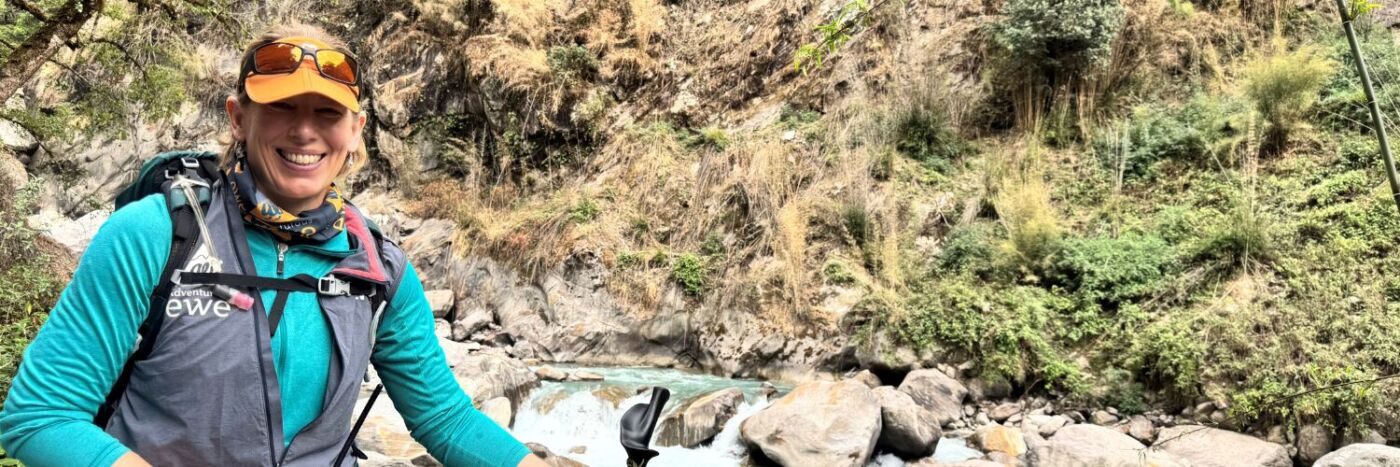
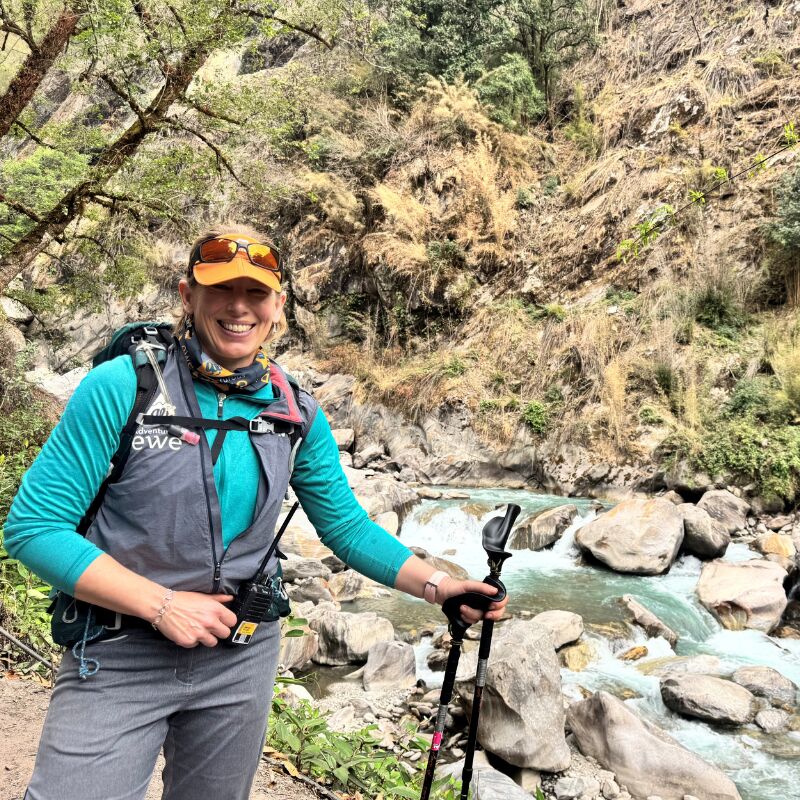
For this climb, you’ll be joined by Everest and 7 Summits mountaineer Jo Bradshaw, who has climbed Mera Peak herself. Jo brings remarkable experience in high-altitude leadership, technical skills and expedition mindset — alongside the warmth, encouragement and support that make her an exceptional guide. Her first-hand knowledge of Mera Peak ensures you’re supported by someone who deeply understands the challenge ahead.
Sherpa Guides & Local Climbing Guides
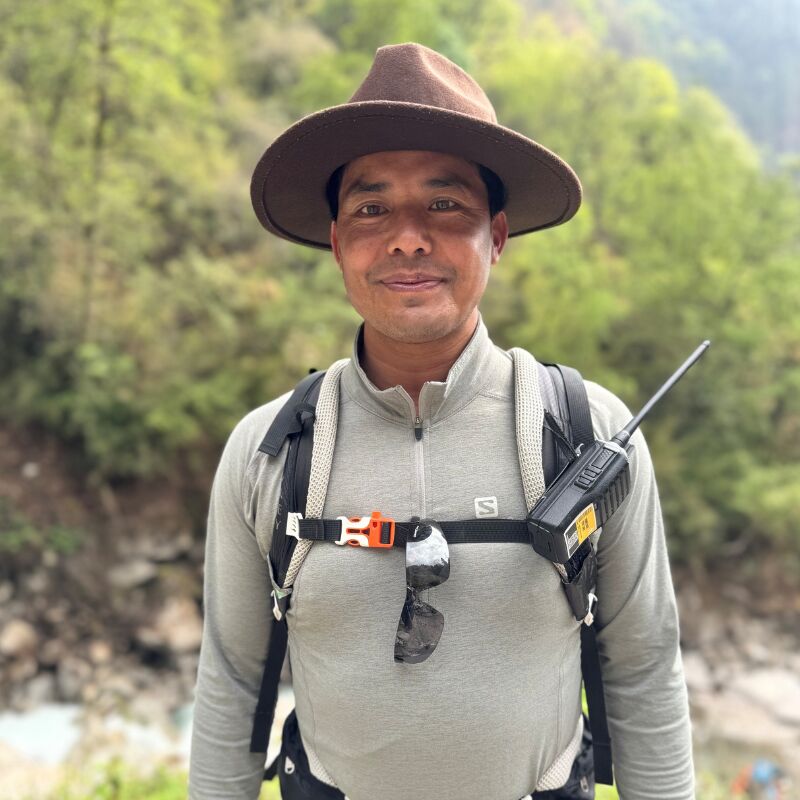
Our Sherpa team are the true heartbeat of the expedition. Highly experienced, English-speaking and deeply familiar with the Inkhu Valley, glacier terrain and summit route, they bring invaluable insight and unwavering support to the climb. Their skill in pacing, safety management and altitude awareness ensures you’re in expert hands from Lukla to the summit and back.
Alongside your Lead Guide, you’ll also be supported by a specialist Local Climbing Guide, trained in technical snow and ice travel, ropework, and high-altitude decision-making.
Communication is maintained throughout the expedition via Garmin InReach, mobile networks and radio, keeping both the mountain team and our Kathmandu office fully connected.
Porters & Mountain Crew
Your expedition is supported by:
• 1 porter per trekker
• Additional high-altitude porters for the upper mountain
• A dedicated kitchen crew for Base Camp and High Camp
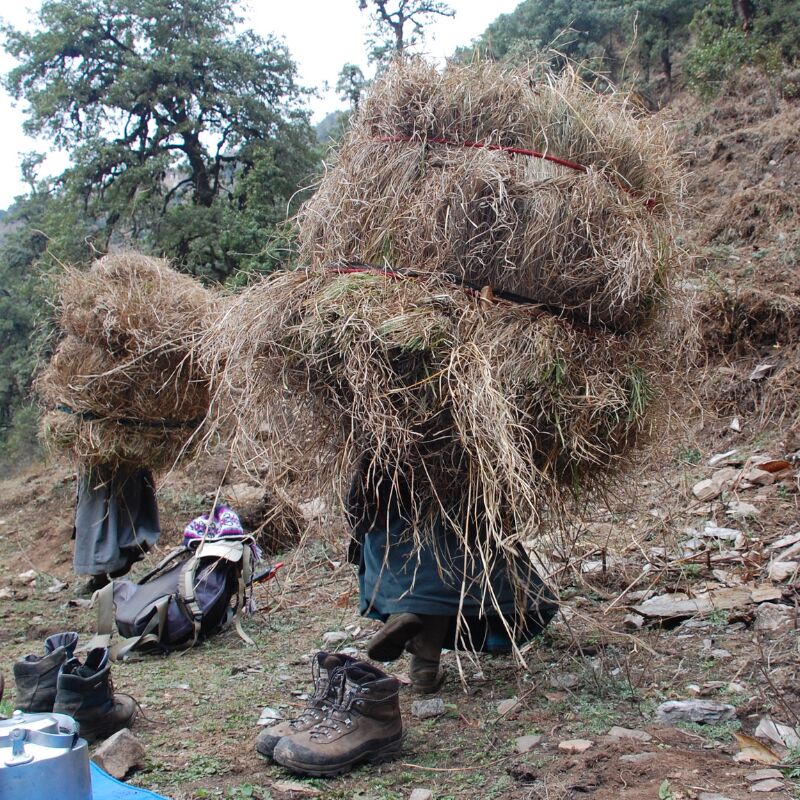
These team members carry essential equipment, prepare meals on the mountain and help create a supportive, positive atmosphere throughout the journey.
Porter Welfare
Our porters are valued members of the team — not just staff. We follow international porter welfare standards to ensure they are well supported throughout the expedition. All porters are:
• Fairly paid
• Properly insured
• Provided with suitable clothing, equipment, meals and accommodation
Respect, dignity and care are central to how we operate. On Mera Peak, everyone moves forward together — as one team.
We proudly specialise in small group adventures — not only to create a more personal and supportive experience, but also to reduce environmental impact, strengthen safety on the mountain, and foster genuine connection with the landscapes and communities you encounter.
The Mera Peak Expedition operates with a minimum group size of 6 and a maximum of 10 trekkers. This keeps the team close-knit, ensures exceptional guide-to-trekker ratios, and creates the right conditions for a supportive, united summit attempt.
You’re welcome to join this expedition as a solo traveller, with friends or family, or as part of a charity fundraising challenge — many of our trekkers climb in support of causes close to their hearts.
If you have a group of 6 or more, we’d be delighted to organise a private departure tailored specifically for your team, charity or organisation. Whether you’re looking for a particular date, pace or focus, we can shape the expedition to suit your needs.
To discuss a bespoke Mera Peak Expedition, just get in touch at info@adventurousewe.co.uk — we’d love to help bring your adventure to life.
How Tough is This Expedition?
The Mera Peak Expedition is graded Extreme. This is a high-altitude mountaineering challenge involving multiple consecutive days above 4000m, glacier travel, long summit-day hours, and sustained physical effort in cold, remote conditions. You will reach a maximum altitude of 6476m on the summit — over 1000m higher than Everest Base Camp (5364m).
This is a demanding expedition that requires a good level of fitness, previous trekking experience, strong mental resilience and a readiness for the realities of expedition life.
You’ll encounter a range of terrain, including rocky trails, steep ascents and descents, glacial moraine, exposed sections and travelling roped-up on snow slopes. Nights at Base Camp and High Camp involve sleeping in expedition tents in freezing temperatures, with limited facilities and long days between rest points.
Acclimatisation days are built carefully into the itinerary to help support your ascent, and your expert Sherpa team — alongside Jo Bradshaw — will guide, encourage and monitor you every step of the way.
If you’re a determined mountain walker with previous experience at altitude, and are ready to embrace both challenge and adventure, Mera Peak offers one of the most rewarding non-technical climbs in the Himalaya.
Altitude & Mountain Conditions
At high altitude, it’s normal to experience shortness of breath, reduced appetite, restless sleep and general fatigue. Your acclimatisation schedule has been designed to minimise risk by ascending gradually, incorporating training days, and adding contingency time for weather or altitude-related delays.
Be prepared for:
• Basic accommodation in mountain teahouses
• Nights in expedition tents at Base Camp and High Camp
• Very cold temperatures, especially overnight
• Limited washing and toilet facilities
• Rough, uneven and glaciated terrain
• Long trekking days carrying a 30–35 litre daypack
This is a true Himalayan expedition — remote, challenging and deeply fulfilling. With the right preparation, teamwork and leadership, it becomes an unforgettable life experience.
Who Is This Expedition For?
This expedition is suitable for those who:
• Have previous trekking experience, ideally at altitude or on multi-day mountain routes
• Are confident walking on uneven terrain for long periods
• Are comfortable carrying a daypack for extended hours
• Have strong fitness and endurance
• Are willing to embrace discomfort, stay flexible and support their teammates
• Are motivated by challenge, adventure and the spirit of the mountains
If you’re ready for a powerful, committed and meaningful high-altitude challenge, Mera Peak is one of the finest and most achievable Himalayan summits you can stand on.
Mera Peak is a true high-altitude expedition, with several nights spent above 4000m, time at Base Camp and High Camp, and a summit at 6476m. At this elevation, the air holds significantly less oxygen than at sea level, and your body will need time to adapt.
It’s completely normal to experience shortness of breath, reduced appetite, mild headaches, disrupted sleep and general fatigue as you ascend. These are typical signs of your body adjusting to altitude, and your carefully structured itinerary — including multiple acclimatisation days and a staged ascent to High Camp — is designed to support this process safely.
Your Sherpa Guides and Jo Bradshaw will monitor the group closely throughout the expedition, using their experience to spot early symptoms of altitude-related issues and adjust pacing when needed.
What to expect at altitude
• Long trekking days at high elevation
• Very cold temperatures, especially overnight
• Lower oxygen levels, slower pace and reduced appetite
• Basic facilities in teahouses and limited comfort at higher camps
• Sleeping in expedition tents at Base Camp and High Camp
• Carrying a 30–35 litre daypack with personal essentials
Hydration, rest and steady pacing become especially important at altitude, and your team will help guide you through this. The acclimatisation process is as much about patience and mindset as it is about physical fitness.
With the right preparation and support, trekking at altitude becomes one of the most rewarding parts of the Mera Peak experience — offering clarity, perspective and a deep connection to the mountain environment.
The Mera Peak Expedition is graded Extreme, and solid preparation is essential for both your safety and your overall enjoyment. With long trekking days, sustained time above 4000m, glacial terrain and a demanding summit push to 6476m, you’ll need strong endurance, resilience and confidence in your physical ability.
You don’t need to be an elite athlete — but you do need to be comfortable walking for consecutive days with a daypack, tackling steep ascents and descents, and embracing the realities of a high-altitude expedition.
What to focus on
Endurance walking
Regular full-day hikes (5–8 hours) on hilly, uneven terrain are the best preparation. Back-to-back training days help replicate expedition conditions.
Leg & core strength and stamina
Strengthen your legs and core with step-ups, lunges, squats, weighted stairs and uphill hiking. These build the power needed for sustained climbs and descents.
Cardiovascular fitness
Incorporate running, cycling, fast hiking or swimming to build cardiovascular capacity — crucial when moving at altitude where oxygen levels are significantly reduced.
Carrying weight
Train with a 30–35 litre daypack (8–10 kg) to mimic what you’ll carry on the trail. This improves comfort, balance and endurance.
Terrain confidence
Practice on rocky paths, loose ground, scree, uneven steps and ridgelines. Confidence in your footing makes glacial and moraine travel much smoother.
Mental resilience
Altitude, cold, basic facilities and long days can test even the fittest trekkers. A positive mindset, flexibility and a team-first attitude are just as important as physical strength.
High-altitude experience
Previous experience above 3,500m helps, but it’s not essential. Your acclimatisation schedule is designed to support you progressively and safely.
Training support from us
To support your preparation, you’ll receive a comprehensive Training Guide once you book — packed with practical tips, exercises, weekly plans and advice tailored to an extreme-altitude expedition.
The more prepared you are, the more you’ll enjoy the journey — and everything it brings along the way.
Our motto:
Train hard, smile harder, and enjoy the journey.
Having the right kit is essential for a safe, warm and enjoyable Mera Peak Expedition. You will be trekking through forests, high valleys and rocky moraine before stepping onto the glacier for the final ascent, where temperatures can drop well below –20°C. A well-planned layering system, reliable footwear, and appropriate mountaineering equipment are key to staying comfortable and confident throughout the journey.
Once you’ve booked, you’ll receive a comprehensive Mera Peak Kit List, outlining exactly what you need for lower valley trekking, high-altitude camping, and summit day. Below is an overview to help you prepare.
Bags
To keep porter loads safe and manageable:
-
1 duffel bag (70–80L) for porters
-
Maximum 12kg of personal kit (including sleeping bag)
-
Soft-sided bags only — no hard suitcases
-
-
1 daypack (40–45L) with a hip belt, waterproof cover and ice axe loops
-
You’ll carry: water, snacks, layers, sun protection, camera, etc.
-
One porter will carry equipment for every two trekkers.
Clothing (Layering System)
Mountain weather is unpredictable, and layering is essential. You’ll need:
Base Layers
-
Merino or synthetic thermal tops (2–3)
-
Thermal leggings
Mid Layers
-
Fleece or warm hoody
-
Light insulated jacket
Outer Layers
-
Waterproof Gore-Tex (or similar) jacket
-
Waterproof trousers
Insulation for High Altitude
-
Expedition-weight down jacket (comfort to –20°C, helmet-compatible hood)
-
Insulated trousers
-
Fleece trousers or hardshell trousers
Trekking Clothing
-
Lightweight trekking trousers
-
Hiking shorts
-
Trekking t-shirts/shirts (merino recommended)
-
Underwear
Gloves
-
Liner gloves
-
Softshell gloves
-
Heavy insulated shell gloves
Footwear
Your feet will take you to 6476m — good footwear matters.
-
Waterproof hiking boots (broken in, with ankle support)
-
B3-rated double mountaineering boots for higher altitudes
-
e.g., La Sportiva G2 or similar
-
-
Trainers or lightweight shoes for evenings
-
Sandals/flip-flops for teahouses
-
Socks:
-
2 liner pairs
-
3 mid-weight pairs
-
2 warm heavyweight mountain pairs
-
-
Gaiters
-
Microspikes (optional for lower sections)
Technical Climbing Equipment
(Available to hire in Khare)
-
Steel 12-point crampons with anti-balling plates
-
Climbing harness
-
Helmet
-
Ice axe
-
Carabiners (3 locking, 2 non-locking)
-
Jumar/ascender if needed (route-dependent)
Your detailed kit list will confirm the precise requirements for your departure.
Sleeping
You’ll camp at Base Camp and High Camp.
-
4-season sleeping bag, rated to –20°C
-
Sleeping bag liner
-
Sleeping mat (high-quality insulation recommended)
-
Pillowcase (optional)
Head & Face
-
Wool hat/beanie
-
Buff/neck gaiter
-
Sun hat
-
Sunglasses – wrap-a-round with UV protection
-
Glacier glasses
-
Ski goggles (for summit day)
-
Balaclava
-
Headtorch + spare batteries
Toiletries & Personal Items
-
Travel towel
-
High SPF sunscreen (50+)
-
Lip balm (SPF 50+)
-
Moisturiser
-
Soap, shampoo
-
Hand gel
-
Toilet paper
-
Pee bottle (men) / pee funnel (women)
-
Small biodegradable waste bags
-
Personal medication & blister care
-
Earplugs
Remove unnecessary packaging before departure — all waste must return to Kathmandu.
Other Essentials
-
2 x 1L water bottles + optional hydration bladder
-
Water purification tablets/system
-
Thermal flask
-
Mobile charger & power bank
-
Universal plug adaptor
-
Repair tape
-
Sewing/repair kit
-
Small folding knife
-
Spare passport photos for permits
-
Reading book/Kindle/cards for downtime
Hire in Nepal
You can hire the following in Kathmandu or Khare:
-
Double/expedition climbing boots
-
Sleeping bags
-
Down jackets
-
Some technical climbing equipment
We recommend bringing your own for comfort and fit, but hiring is a good option if you prefer to travel lighter.
(We’ll advise on current hire costs and help you arrange this once booked.)
Buying Gear in Kathmandu
Kathmandu has many outdoor shops:
-
Some stock high-quality branded kit at similar UK prices
-
Others sell cheaper imitation gear (quality varies)
-
You can easily buy a porter duffel bag on arrival
Hydration & Environmental Impact
To help reduce single-use plastics, you’ll receive a complimentary Adventurous Ewe Water-to-Go bottle (or a replacement filter for returning trekkers). Clean water will be available throughout the expedition.
Kit Support
If you’re unsure about any item — what to hire, what to buy, or how something should fit — we’re here to help. You’ll also receive exclusive discounts with UK outdoor retailers once you book.
The best seasons to climb Mera Peak are March–May and September–November, when conditions in the Himalaya are generally more stable, dry and favourable for high-altitude travel.
Autumn (Mid-September to November)
This is Nepal’s main trekking season. Skies are typically clear, visibility is excellent and the trails are dry.
-
Kathmandu daytime temps: 20°C+
-
Around 3,600m: 10°C
-
Above Khare and onto the glacier: very cold, with nights dropping to –20°C to –30°C
Autumn offers the clearest mountain views but is colder at higher elevations, especially between the Mera La, High Camp and the summit.
Spring (March to May)
Temperatures are warmer and the days feel more comfortable for trekking, though afternoon haze is common and rainfall or snowfall can occur.
-
Kathmandu can reach 35°C in peak spring
-
The lower valleys are warm, with blooming rhododendrons
-
Higher up, the mountain remains cold with snow around the Mera La and High Camp
Typical temperatures
-
At 3,800m (Khare):
-
Day: around 10°C
-
Night: around –4°C
-
-
At High Camp (5,800m):
-
Nights: –15°C to –25°C
-
Summit day including windchill: as low as –30°C
-
Summit Day Conditions
Summit day begins very early, and temperatures are at their coldest.
Expect:
-
Sub-zero temperatures well below –20°C
-
Strong winds, particularly around the Mera La and summit ridge
-
Hard-packed snow and icy sections
-
Exposure to extreme cold — keeping moving is essential
Your guides will advise on pace, warmth and safety throughout.
Expect the unexpected
Mountain weather is never fully predictable. Snow, wind, cloud build-up and sudden temperature drops can occur in any season. You must come equipped for all conditions, including extreme cold, snowstorms and high winds.
The itinerary has built-in flexibility to help manage weather-related changes, and your Sherpa guides and Jo Bradshaw will make informed decisions to keep the team safe and give you the best chance of a successful summit.
Your Mera Peak Expedition includes a mix of hotel stays, basic mountain teahouses and high-altitude camping — giving you a genuine experience of life in Nepal, both in the city and high in the Himalaya.
Across the expedition, you’ll spend:
• 2 nights at Kathmandu Guest House (Deluxe rooms)
• 1 night at Freedom Resort in Manthali
• 12–13 nights in basic teahouses on the trail (dependent on contingency day)
• 2–3 nights camping at Base Camp and High Camp (dependent on contingency day)
All accommodation is on a twin-share basis.
Kathmandu: Kathmandu Guest House (Deluxe Room)
In Kathmandu, you’ll stay at the renowned Kathmandu Guest House — a comfortable, welcoming base in the heart of Thamel. Rooms are en suite, the courtyard gardens are a peaceful escape from the city streets, and the hotel has its own restaurant, café and lounge spaces.
Free Wi-Fi is available, with stronger connection in common areas and login codes for the rooms available at reception.
Manthali: Freedom Resort
Before flying to Lukla, you’ll stay at Freedom Resort in Manthali — the closest and best available accommodation near the regional airport. Rooms are simple but clean, with en suite facilities, air-conditioning and a selection of local Nepali meals served on site.
This night allows you to rest and reset before flying into the mountains the following morning.
Teahouses on the Trek (12–13 nights)
Teahouses in the Himalaya are basic but welcoming, and an essential part of experiencing life in remote Nepali communities. Please be realistic about what to expect in the mountains — facilities become more basic the higher you go.
Most teahouses offer:
• Twin-share rooms with foam mattresses, bedsheets and pillows
• A communal dining room (the warmest place in the building)
• Basic toilets — usually squat-style, sometimes outside the main building
• Limited electricity, often solar-powered
• Snacks and simple supplies for sale (tissues, soap, toilet paper)
Heating is not guaranteed. Some teahouses may offer a stove in the dining room for an additional fee; rooms are typically unheated.
Hot showers may be available in lower villages (charged at approx. NPR 250–500), though at higher altitudes this is often a bucket of hot water rather than a powered shower. Facilities become colder and more basic from Thangnak upwards.
A few of the teahouses we use are part of our local team’s Support Rural Nepal initiative — helping restore traditional buildings, create employment for local artisans and strengthen rural village economies.
Camping: Base Camp & High Camp (2–3 nights)
At Base Camp and High Camp, you’ll sleep in expedition tents on a twin-share basis. Nights here are extremely cold, and conditions are simple and rugged — part of the authentic high-altitude experience.
Expect:
• Sub-zero temperatures
• Limited space
• A central dining tent
• No fixed toilet facilities
• Hot drinks and nourishing meals prepared by your dedicated mountain kitchen crew
Your Sherpa team will manage all camp logistics, ensuring you stay as warm, safe and comfortable as possible at altitude.
Extra Nights in Kathmandu
If you’d like to extend your time in Nepal before or after the expedition, we can arrange additional nights at the Kathmandu Guest House.
Please enquire at info@adventurousewe.co.uk when booking.
Single Supplement
A single supplement is available for hotel nights in Kathmandu only (subject to availability).
Single rooms cannot be guaranteed in teahouses due to limited space at altitude. If a single room is available on the day, you may request and pay for it locally.
Food & Drink
Your Mera Peak Expedition includes 19 breakfasts, 18 lunches and 19 dinners, served in a mix of teahouses along the trail and by your dedicated mountain kitchen crew at Base Camp and High Camp. Dining in the Himalaya is a memorable part of the journey — simple, hearty meals shared around warm stoves, often with spectacular views just outside the window.
Eating well is essential for acclimatisation and energy at altitude, and your crew will do everything possible to ensure you’re well fuelled throughout the expedition.
Meals on the Trek
Breakfast
Breakfast is served in the teahouse dining room and typically includes a selection of:
-
Tibetan bread, chapati or toast
-
Eggs (fried, boiled, scrambled or omelette)
-
Muesli or porridge
-
Pancakes (available at some lodges)
-
Tea or coffee
Menus vary with altitude and supply availability, especially in remote villages — flexibility is key.
Lunch & Dinner
Lunch is usually taken en route at a local teahouse, while dinner is served at the lodge where you stay each night. Common dishes include:
-
Dhal bhat – Nepal’s classic dish of rice, lentils and vegetables (unlimited refills)
-
Momos – steamed or fried dumplings
-
Fried rice or vegetable noodles
-
Pasta and simple soups
-
Potato dishes (rosti, chips, fried potatoes)
At Base Camp and High Camp, our mountain kitchen team prepares hot, energy-rich meals designed for altitude, focusing on carbohydrates, warmth and hydration.
Special Diets & Allergies
Food in remote mountain areas is basic and largely carbohydrate-based. While our team will do their best to support dietary needs, please be realistic about what is possible at 5000m+.
Gluten-Free Trekkers
Options are limited. We strongly recommend bringing extra snacks and supplements. Expect:
-
Fried rice or boiled potatoes
-
Eggs
-
Porridge made with water
-
Vegetable soups (where safe)
Stock cubes and sauces in Nepal often contain gluten.
Vegan / Lactose Intolerance
Expect:
-
Rice and vegetable dishes
-
Muesli or porridge with water
-
Fried potatoes
-
Vegetable soup
Your Leader will help communicate your needs, but ingredients are limited the higher you go.
Important: Bring your own specialist snacks, electrolyte powders and comfort foods — they make a big difference at altitude.
Snacks & Extras
You can:
-
Bring snacks from home (remove excess packaging before travel)
-
Buy local snacks in Kathmandu
-
Purchase limited snacks on the trail
Imported chocolate, Pringles, soft drinks and energy bars become very expensive at higher altitudes.
Water
Hydration is essential at altitude — you should aim to drink 3–5 litres per day.
To reduce plastic waste, we strongly discourage buying bottled water in the mountains.
Water Options
Boiled water
Available to purchase at most teahouses (approx. NPR 150–300 per litre, increasing with altitude).
Water-to-Go Bottle
You’ll receive a complimentary Adventurous Ewe Water-to-Go bottle, which filters 99.99% of microbiological contaminants from any non-salt water source.
-
Perfect for streams, taps and lodge water
-
Do not add electrolytes or flavourings — they damage the filter
Purification tablets
Ideal for treating water in a hydration bladder or standard bottle if you want to use electrolytes or flavour powders.
Cold weather tip:
If your Water-to-Go filter freezes, defrost it in lukewarm water for 10–15 minutes before use.
Using refillable bottles and filtration protects the fragile mountain environment and keeps plastic waste out of Nepal’s remote valleys.
Adventurous Ewe has partnered with Water-to-Go, a filtration system that eliminates over 99.99% of all microbiological contaminants from any non-salt water source – for more info please click here. Adventurous Ewe trekkers will receive a free Water-to-Go bottle on departure, and better still, 15% of the purchase value for replacement filters will be donated to our environmental charity partner, Cool Earth. Please note that if the water freezes it will clog up the filter – in this event, defrost before use by sitting the filter in lukewarm water for 10-15 minutes. Please help us reduce the volume of single use plastic in this pristine environment.
Deposit: £265 per person on booking and non-refundable
Balance: £4000 per person is due no later than 60 days prior to the trip start date
Total cost: £4265 per person
Monthly payment plan
A monthly payment plan can be arranged for this trip. Please contact us for more information or to set up your plan. Simply email info@adventurousewe.co.uk or call 01492 588 069.
Book & Travel with Confidence
As well as carefully crafting amazing and meaningful adventures across the planet, we’ve made booking them as flexible, safe and as simple as possible.
For the latest info regarding booking and travelling with Adventurous Ewe, please visit our website.
Fundraising
You’re welcome to fundraise for a charity of your choice if you wish to do so. All sponsorship monies are to be sent directly to your chosen charity.
All your trip info will be sent to you through a mobile travel app which is free to download. You will receive an email from Adventurous Ewe with your personalised log in code for this app.
For the latest and greatest from the land of adventures, simply follow us at:
Facebook: @adventurousewe
Instagram: @adventurousewe
Youtube: Adventurous Ewe
LinkedIn: Adventurous-Ewe-Ltd
You’re most welcome to use the hashtags
#ewecandoit #thisflockrock #letsogadventure
Your Adventurous Ewe Leader/s and Crew will have a satellite phone, mobile phones and radios communications in case of emergencies. The team are trained to deal with these situations. Please ensure you listen to your Leader during these times and refrain from putting any posts on social media. Should you find yourself unable to continue with the trek, your Leader and crew will make the necessary arrangements. Depending on the situation, you will be met by the support vehicle (depending on access) and you will be transferred back to suitable accommodation or nearby medical facility as required.
Your Emergency Contact at Adventurous Ewe HQ is Jim Young on +44(0)7747 346 588.
COOL EARTH
We are very excited to have teamed up with leading climate change charity Cool Earth, who share our mission to protect the planet’s precious environment in a sustainable manner. The future of rainforest protection is where everyone makes a difference to climate change! We invest a % of our revenue into supporting critical conservation projects around the world through Cool Earth. You are most welcome to help make a difference too by sparing a few pennies. Please give what you can and help save the world’s rainforests today by clicking here. Just £2.50 will save 10 trees and lock up 10 tonnes of CO2.
Together, we can all make a difference in helping preserve this precious and wonderful planet. Thank-ewe

| Departure & Return | Duration | Availability | Deposit | Total Cost* | (*Total cost includes the deposit) |
| Oct 23, 2027 Nov 11, 2027 |
20 Days | Guaranteed to run | £265.00 | £4265.00 | Book Now |
What's Included?
PRE-TRIP:
- Personalised trip support in the lead up to your trek
- Trek training guide
- Discount on personal kit from independent outdoor retailers both in shop and online
- Trip info supplied via our free mobile travel app
- Public liability insurance
- Financial Protection for your booking – ABTOT
- Monthly payment plan available
- Risk assessment and emergency management planning
- Free Adventurous Ewe Water-to-Go Bottle
DURING YOUR TRIP:
- Local Team:English speaking guide throughout the trip, Local Climbing guide, 1 porter for every pax on the trek, Additional porters & kitchen crew on the expedition
- Accommodation: 2 nights in Kathmandu Guest House (deluxe room), 1 night in Freedom Resort in Manthali, 12 or 13 nights in basic teahouses on the trek, 2 or 3 nights camping (contingency day dependent)
- Meals: Breakfast x 19, Lunch x 18, Dinner x 19
- Private transport: Arrival & departure airport transfers at one nominated time for each, Kathmandu – Ramechhap Airport – Kathmandu
- Internal flights: Manthali – Lukla – Manthali
- Activities/tours: Guided tour of Kathmandu Durbar Square, Swoyambhunath, 11 day trek
- Applicable entry fees/permits:Everest National Park fee, Everest region local development fee, Climbing Permit
- Safety/ Emergency equipment: 1 x Gamow bag, 1 x Oxygen cylinder, 1 x Oximeter, Satellite phone
- All trip management before, during and post trek.
What's Not Included?
- International flights and airport transfers in Nepal (outside of group transfers)
- Travel insurance (mandatory) that covers high altitude trekking and helicopter evacuations
- Any activities/ tours/ visits not mentioned in the itinerary and in the above inclusion list
- Personal climbing/ trekking gear
- Visa – please refer to: https://www.gov.uk/foreign-travel-advice/nepal
- Vaccination/s. Please refer to: https://www.fitfortravel.nhs.uk/destinations/asia-east/nepal
- Personal spending money and drinks
- Meals not listed in your itinerary
- Beverages, drinking water
- Snacks, electrolytes, water purification tablets
- Charges levied by teahouses for hot shower, battery charging, etc
- Kit and equipment as listed on your kit list
- Any personal medication
- Tips/ gratuities if considered earned for guide, assistant guide, climbing guide, porters, expedition crew, drivers & hotel staff
- Single room supplement where available
- Any associated costs with leaving the trek early.
TRIP EXTENSIONS
If you wish to extend your stay in Nepal, we can help you with plenty of recommendations of things to do and see. For more information, please contact us at info@adventurousewe.co.uk.
SUSTAINABLE AND RESPONSIBLE TRAVEL
At Adventurous Ewe, sustainability isn’t an add-on – it’s the foundation of everything we do. As a Travelife Partner, we’re proud to be recognised for our ongoing commitment to responsible travel and continuous improvement in sustainability across all our operations.
The Climb Mera Peak trip has been created to support mountain communities, protect fragile Himalayan environments, and ensure that the people and places of Nepal benefit directly from every expedition.
Our responsible travel in action
- You trek with experienced Nepal mountain guides, porters and support crew, ensuring tourism income goes directly into local hands.
- Accommodation is arranged in smaller-scale, locally owned tea houses and lodges, supporting family businesses across the Khumbu and Hinku valleys.
- Meals feature locally grown and locally prepared food wherever possible, helping sustain farmers, growers and small restaurant owners in remote mountain regions.
- Every trekker receives a complimentary Water-to-Go bottle to help reduce single-use plastic, and returning trekkers receive a new filter.
- All expeditions operate with a Leave No Trace ethos – managing waste responsibly, conserving energy and water, and respecting the delicate ecosystems of the Himalayas.
- Cultural respect is built into the journey. You walk clockwise around stupas, remove your shoes in temples, ask permission before taking photos, and dress modestly in villages where traditions run deep.
- A portion of every booking goes towards Cool Earth, our long-term environmental charity partner working to protect rainforests and empower local communities around the world.
- You also contribute to Support Rural Nepal, helping strengthen vital community initiatives across the region.
Your role as a responsible traveller
- Leave no trace: Carry all rubbish with you and recycle where possible.
- Reduce plastic waste: Use your Water-to-Go bottle and avoid single-use items.
- Travel light: Remove excess packaging from new outdoor gear before you fly.
- Respect local culture: Dress modestly, greet people with warmth, and always ask before taking photos.
- Protect sacred spaces: Walk clockwise around religious monuments, remove shoes when entering temples, and avoid touching statues or ritual objects.
Together, you help safeguard one of the world’s most remarkable mountain landscapes – ensuring that the trails, communities and traditions of the Nepal Himalaya continue to thrive for generations to come.
 Difficulty