Planning a Trek in Georgia: A First-Hand Guide to Svaneti, Tusheti & Khevsureti
Which region should you trek, when should you go and what should you expect in the Caucasus?
By Sue Blunt, Director & Expedition Leader, Adventurous Ewe
If you’re planning a trekking trip to Georgia, three names are likely to keep appearing in your research: Svaneti, Tusheti and Khevsureti.
They are all part of Georgia’s extraordinary mountain story. But having now trekked through all three, I can tell you that they offer very different experiences.
I’ve crossed the high, remote mountain terrain linking Tusheti and Khevsureti in eastern Georgia, travelled and trekked extensively with our Georgian team, returned to develop our Svaneti programme and most recently spent just shy of a month in the country leading two back-to-back Svaneti Highlands Treks.
And the more time I spend there, the less I think of “trekking in Georgia” as one type of adventure.
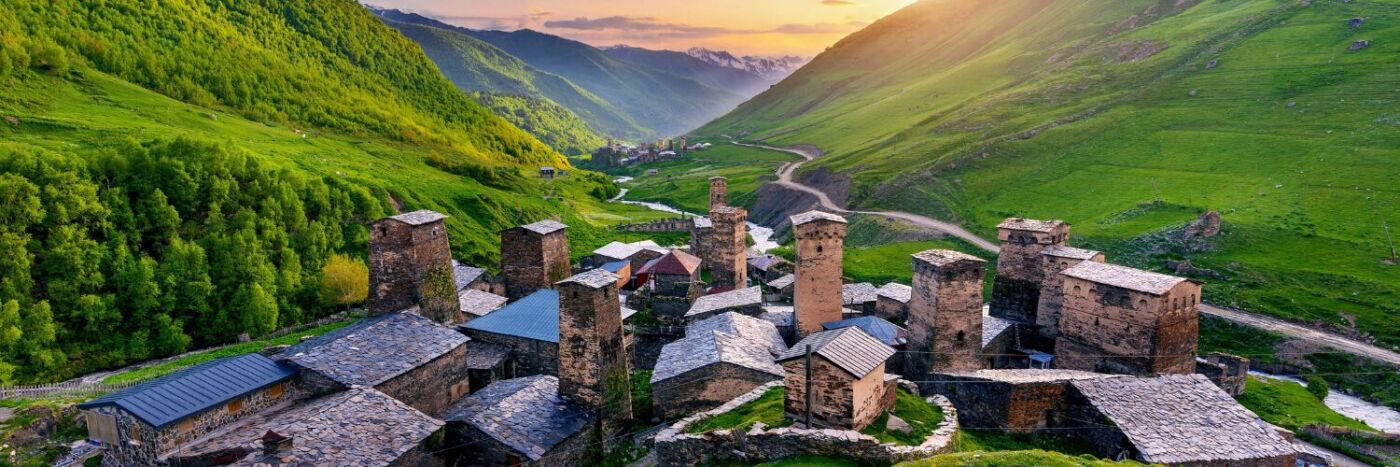
In the west, Svaneti brings glaciers, medieval towers, family-run guesthouses and trails connecting mountain communities.
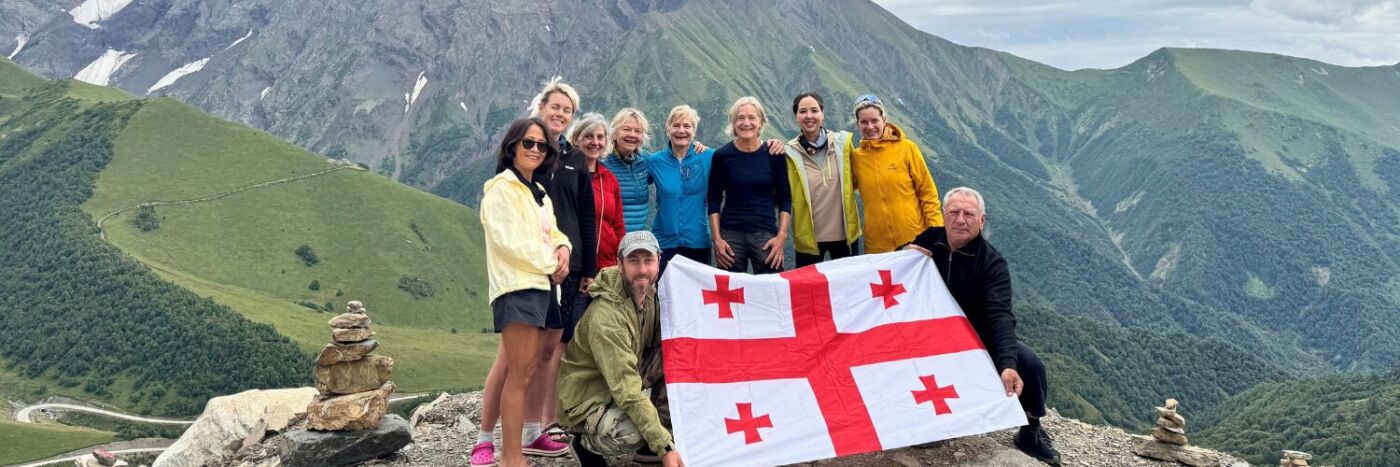
Head east into Tusheti and Khevsureti and everything feels wilder. Camps replace guesthouses for parts of the journey, settlements become more scattered and the mountains themselves become the route as you cross from one historic region into another.
So if you’re trying to work out where to trek in Georgia, which trek is right for you and what you should know before you go, this is what I’ve learnt from travelling these mountains on foot.
Why trek in Georgia?
The Greater Caucasus forms Georgia’s dramatic northern spine, creating a landscape of deep valleys, alpine meadows, forests, glaciers, rushing rivers and enormous mountain passes.
It is superb trekking country.
But I wouldn’t travel to Georgia purely for its mountains.
For me, its greatest strength is the combination of landscape, culture and people.
Mountain communities here have very strong identities of their own. History hasn’t simply been packaged up for visitors; you see it in the towers standing above villages, the shrines beside trails, regional languages, food, music and traditions that remain part of everyday life.
Upper Svaneti, for example, is recognised as a UNESCO World Heritage Site for its exceptional mountain landscape, medieval villages and distinctive defensive tower houses.
Then there is Georgia’s food and wine culture.
Khinkali dumplings. Khachapuri. Fresh breads and cheeses. Salads, stews and grilled meats. Homemade dishes appearing on guesthouse tables after a long day in the mountains.
And, inevitably, wine.
Georgia has a winemaking history stretching back thousands of years and its traditional qvevri method of fermenting and ageing wine in large earthenware vessels is recognised by UNESCO.
But facts only tell part of that story.
Sit around a Georgian table and somebody may take on the role of tamada, or toastmaster. Glasses are raised to family, friendship, Georgia, guests, those no longer around the table and those still to come.
You begin to understand very quickly that hospitality here is about far more than feeding someone.
My first piece of advice: choose the region, not simply “Georgia”
This is probably the most useful thing I can tell anyone beginning their research.
Don’t start by asking:
“Should I trek in Georgia?”
Ask:
“What sort of Georgian mountain experience do I want?”
Our two journeys illustrate the difference particularly well.
At a glance
| Svaneti Highlands Trek | Tusheti & Khevsureti Trek | |
|---|---|---|
| Region | Western Georgia | Eastern Georgia |
| Style | Point-to-point mountain trek | More expedition-style mountain crossing |
| Accommodation | Mainly family-run guesthouses | Mix including nights camping |
| Landscape | Glaciers, valleys, villages and medieval towers | Remote valleys, high passes and isolated settlements |
| Highest trekking point | Around 2,730m | Over 3,400m |
| Community interaction | Frequent | More dispersed because of remoteness |
| Overall feeling | Mountain journey through living communities | Journey across a wilder mountain frontier |
| Best suited to | Trekkers wanting challenge plus cultural immersion | Experienced trekkers drawn to remoteness and a stronger expedition feel |
Neither is the “better” trek.
They’re different chapters of the same Georgian story.
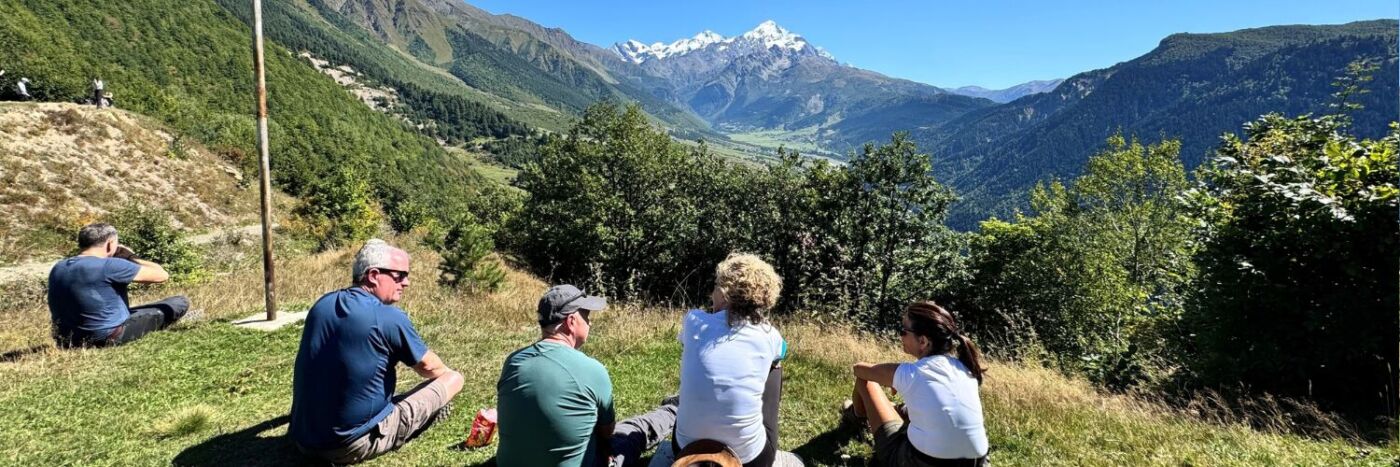
Svaneti Highlands Trek: western Georgia, mountain villages and glaciers
Our Svaneti Highlands Trek – Western Georgia & the Caucasus is the trip I’d point towards if you want strong mountain trekking while still ending many of your days within small communities.
Svaneti feels distinctive almost immediately.
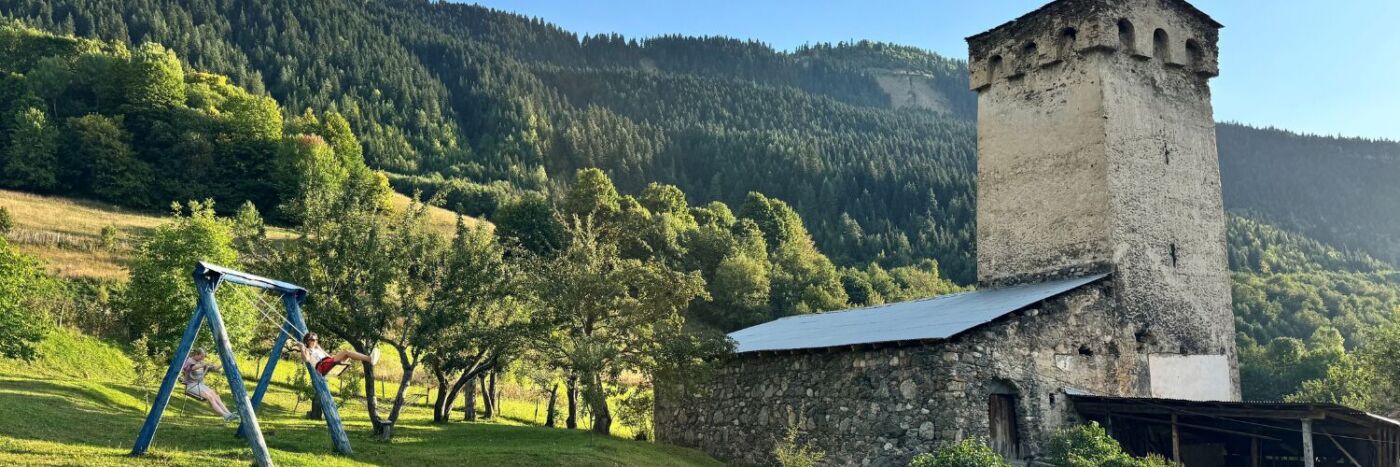
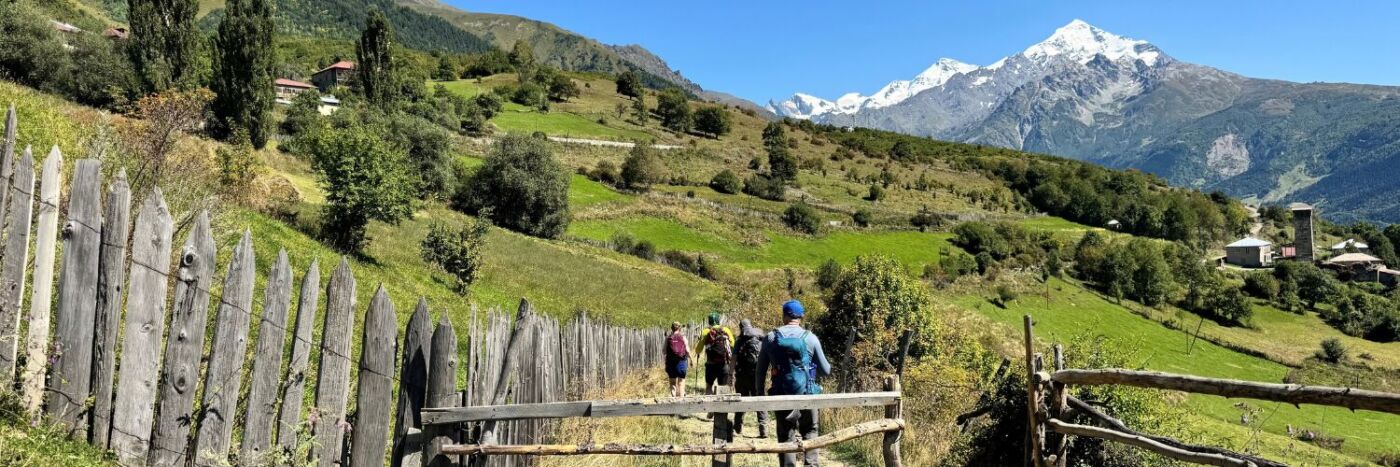
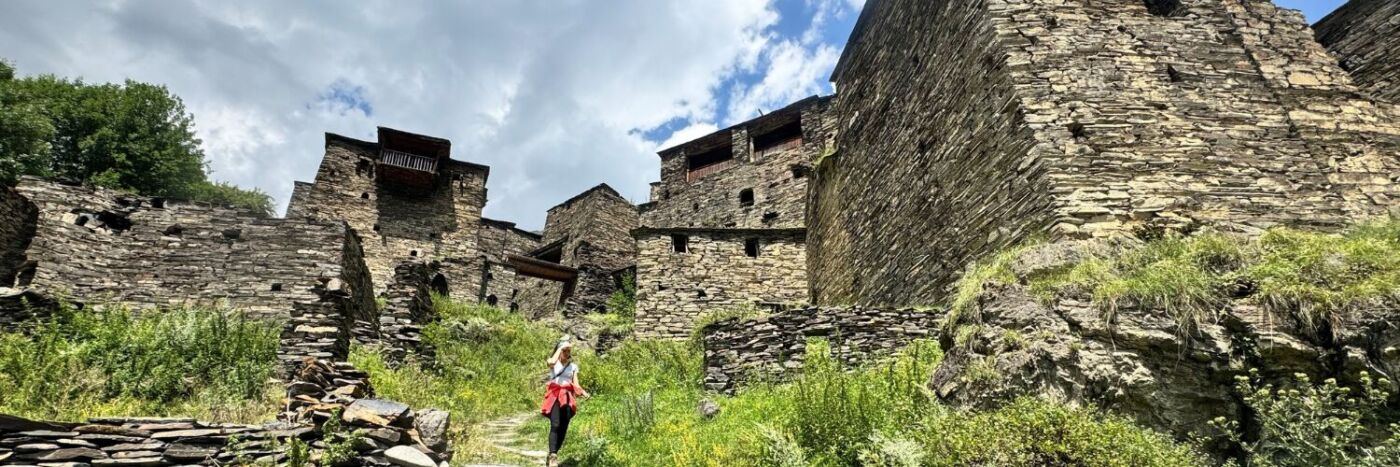
Medieval towers rise above villages. Glaciers spill between huge Caucasus peaks. Cattle wander through settlements. Guesthouses sit among working homes rather than separate from them.
Our point-to-point trek moves through this landscape towards Ushguli, crossing high passes including the approximately 2,730m Chkhutnieri Pass.
But some of my strongest Svaneti memories aren’t necessarily the biggest sights.
A thunderstorm holding us back before we started walking.
The increasing quantity of mud on everyone’s boots.
A tiny mountainside coffee stop appearing at exactly the right moment.
Arriving in Adishi after a demanding day and sitting down together over food prepared by our hosts.
And, strangely enough, the dogs.
Community dogs regularly appeared alongside us. Some stayed for a few kilometres; others seemed determined to complete half the trek. On one final trekking day, seven dogs accompanied our group towards Gorvashi Pass.
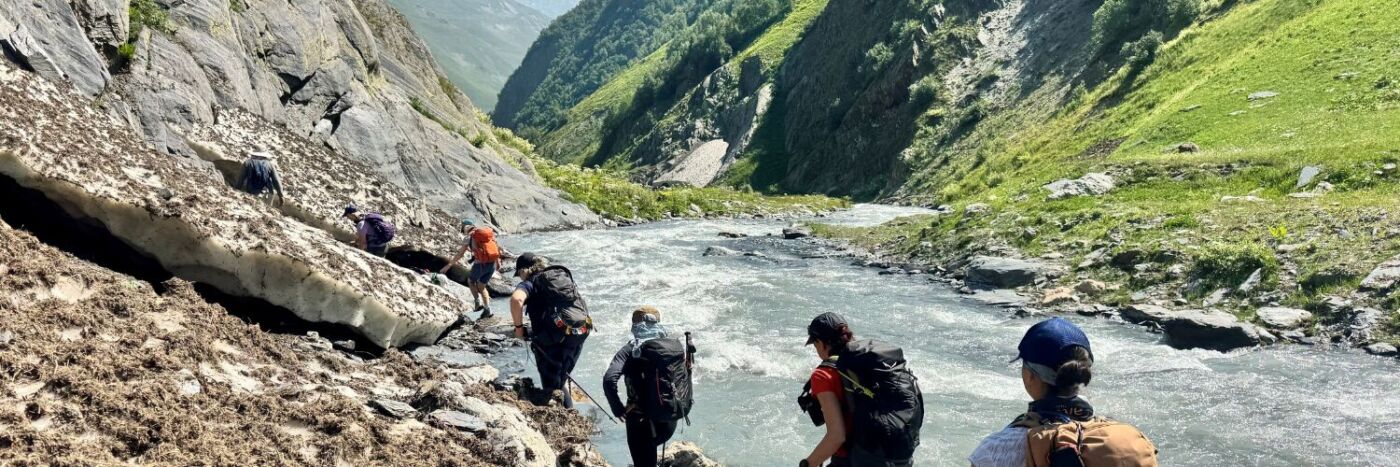
Then there’s the Adishchala glacial river crossing, which can involve crossing on horseback depending on conditions.
It is these unpredictable little elements that give the journey its character.
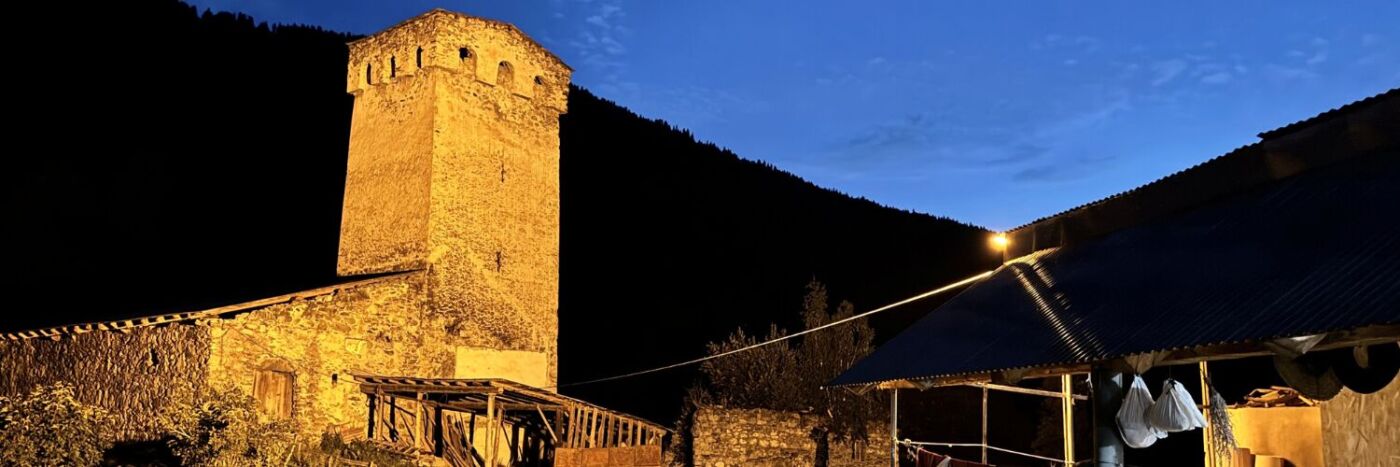
Staying in Svaneti’s villages
One of Svaneti’s real advantages is the opportunity to stay within mountain communities.
Don’t expect polished resort hotels.
That isn’t the point.
The guesthouses allow you to finish a day amongst the people who live in these valleys, eat home-cooked Georgian food and experience something of contemporary life in this extraordinary landscape.
And sometimes the experience becomes considerably more personal.
On our latest journey, our Svan guide Svani invited our group to his family home.
His brother Rostom and friend Gia joined us. The barbecue was lit. Food appeared. Drinks were poured. Then came the toasts.
Nothing about it felt staged for visitors.
It was simply somebody we’d been trekking alongside opening his home to us.
Those moments can’t be written into an itinerary and guaranteed.
But we can design trips that give them room to happen.
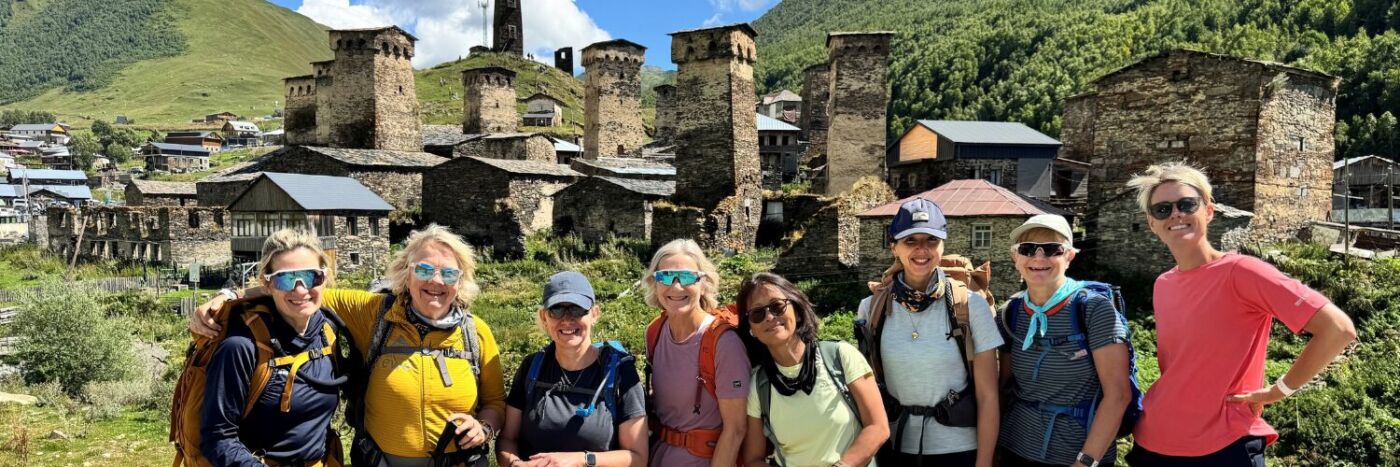
Understanding Svaneti beyond the walking
I increasingly believe that knowing something about a place changes the way you walk through it.
In Ushguli we watched the Georgian film Dede, directed by Mariam Khatchvani and set within this remote Svan community.
Watching it there, surrounded by the landscape and traditions that shaped the story, gave another context to the stone houses, isolation and customs we’d been encountering along the trail.
You begin to see Svaneti as more than a spectacular mountain backdrop.
You’re trekking through a living cultural landscape.
Explore the Svaneti Highlands Trek – Western Georgia & the Caucasus
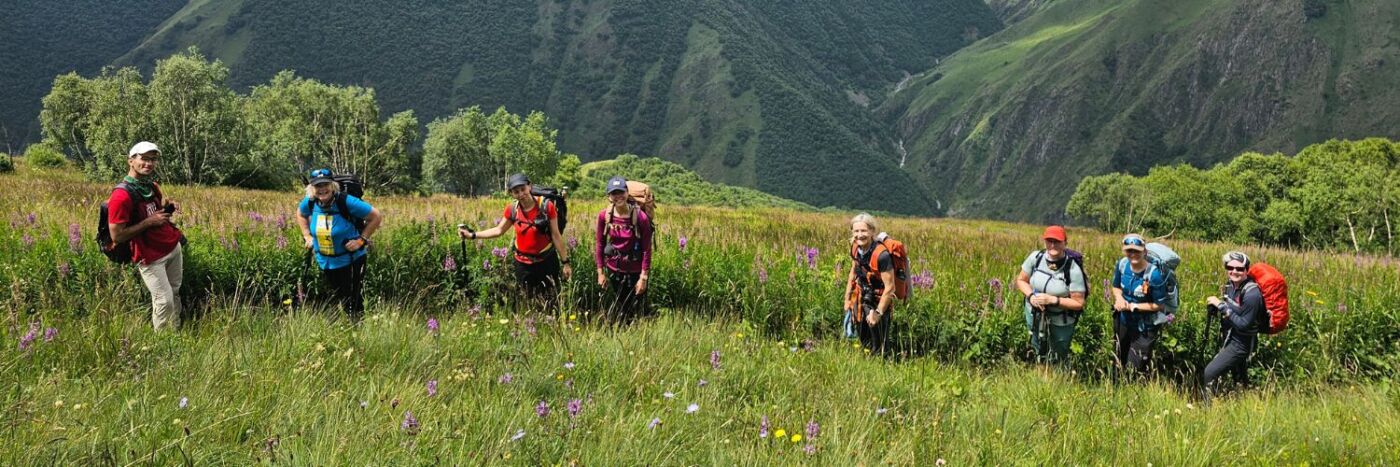
Tusheti & Khevsureti Trek: eastern Georgia gets considerably wilder
Travel east and the nature of the journey changes.
Our Tusheti & Khevsureti Trek – Eastern Georgia & the Wild Caucasus has much more of an expedition feel.
Rather than remaining within one mountain region, the route takes you from Tusheti across the Caucasus into Khevsureti.
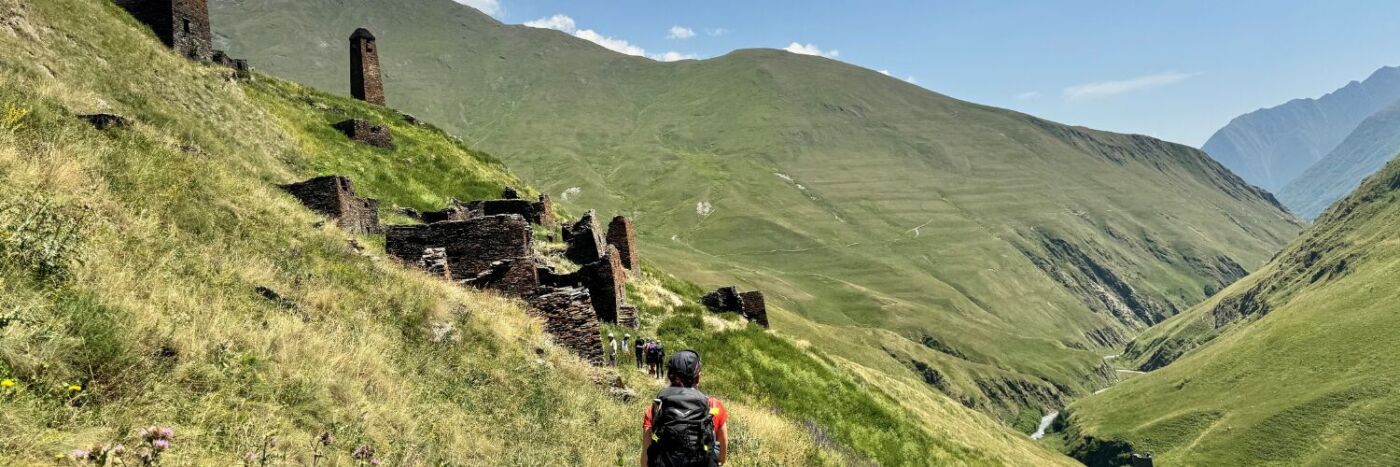
You travel through Dartlo and Girevi before making the high mountain crossing towards Khevsureti and the historic fortified settlements around Mutso and Shatili.
This is big trekking country.
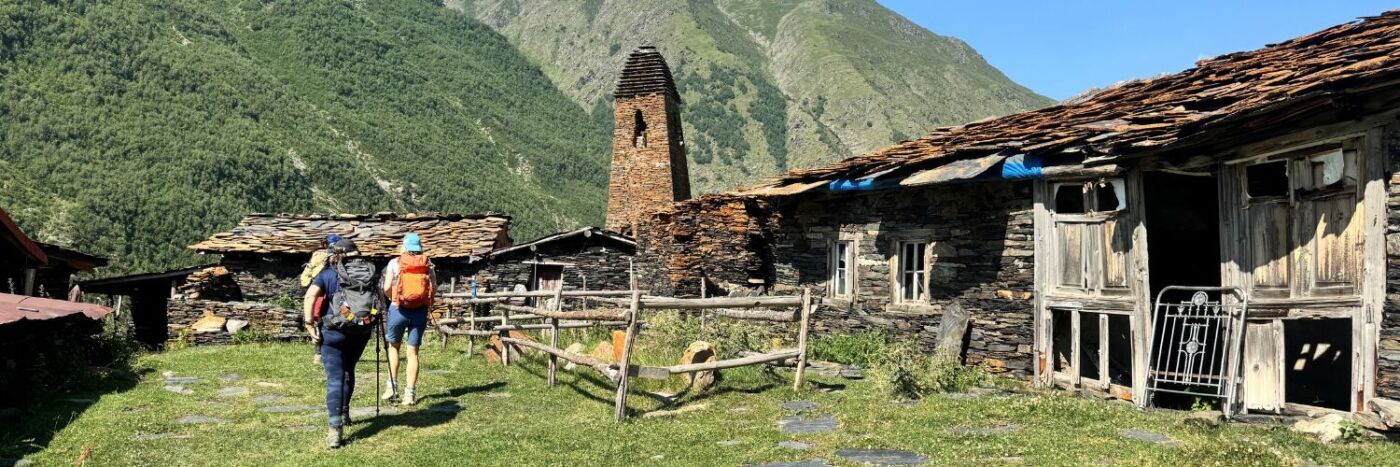
There are long days, nights under canvas, river valleys and high passes, including the Atsunta crossing at well over 3,400m.
The sense of isolation is markedly greater than in Svaneti.
For anyone considering this trek, that’s important to understand.
The remoteness isn’t simply something we use to describe it.
It fundamentally changes the experience.
You need to be comfortable with camping, longer mountain days, changing weather and simpler facilities. You also need the fitness and mindset to keep moving through terrain where your destination can still feel a very long way away.
For the right trekker, that’s exactly its appeal.
What I remember most about Tusheti
Again, however, my memories aren’t simply of the big mountain passes.
I remember shepherds and horses.
Stopping and talking rather than walking straight past.
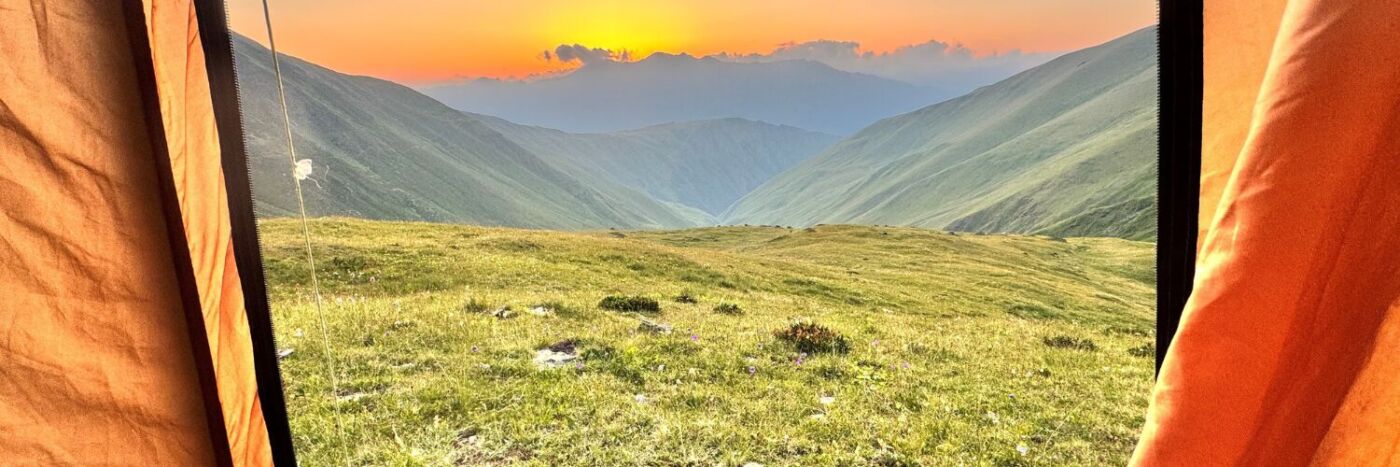
The silence after everyone disappeared into their tents at camp.
Changing light running across the mountains.
Stone villages that seem almost absorbed into the landscape.
Eating khinkali.
Trying Aludi, the traditional local beer.
And conversations with our Georgian guides that might begin with a question about the trail and somehow end up exploring Georgian history, family life, food or regional traditions.
One of those conversations actually changed our Georgia programme.
I was trekking through Tusheti with Kote, one of our Georgian team, when he started telling me about his homeland in Svaneti and said I needed to experience it.
So I did.
I went home, researched the region, talked extensively with our Georgian partners and returned to develop what became our Svaneti Highlands Trek.
That’s one of the reasons I keep going back to Georgia.
There is always another valley, story, community or part of the country that somebody who knows it intimately wants to show you.
Explore the Tusheti & Khevsureti Trek – Eastern Georgia & the Wild Caucasus
When is the best time to trek in Georgia?
For high mountain trekking, your season is dictated by snow, road access, trail conditions and mountain weather.
Tusheti has a particularly short season because access into the region crosses the high Abano Pass and conditions can change quickly.
Svaneti offers a little more flexibility, but high passes still demand respect.
And don’t equate travelling in summer or early autumn with guaranteed sunshine.
During our September Svaneti journeys we’ve encountered hot sun, thunderstorms, heavy rain, cool conditions and substantial amounts of mud.
Sometimes remarkably close together.
This is the Caucasus.
Come prepared for mountain weather rather than a particular forecast.
How fit do I need to be?
Both treks are proper mountain journeys rather than sightseeing trips with an occasional walk.
You don’t need to be an elite athlete.
You do need to arrive prepared.
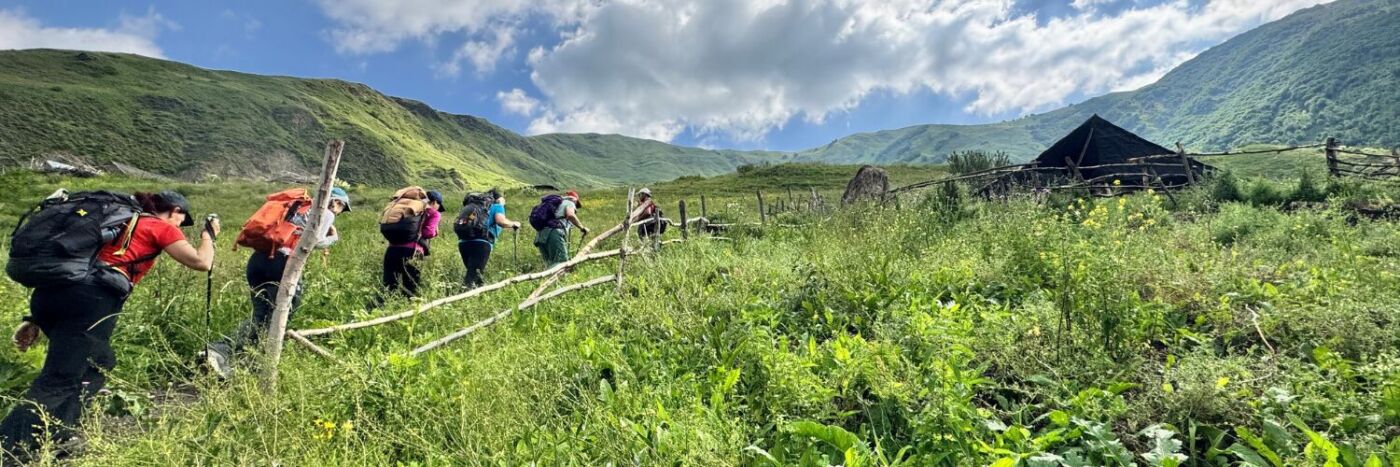
That means building the endurance to walk for consecutive days, developing strength for long ascents and descents and, ideally, training on rough and uneven terrain rather than doing everything on a treadmill or flat path.
Train wearing the walking boots and rucksack you intend to take.
If you’re going to use trekking poles, train with those too.
For Tusheti & Khevsureti, previous trekking experience becomes particularly valuable because you’re dealing with longer days, camping, greater isolation and a high pass above 3,400m.
Svaneti still presents demanding mountain days, but the village-to-village format and lower maximum altitude create a different style of challenge.
What should I pack for trekking in Georgia?
Don’t underestimate the value of good mountain kit here.
From my recent trips, there are a few things I’d particularly prioritise:
Properly worn-in walking boots. Mud, rock, steep descents and wet ground can all feature.
Reliable waterproofs. Not the jacket you’ve carried for years but never actually worn in heavy rain.
Layers. Conditions at a pass can feel very different from those in the valley below.
Trekking poles. Particularly useful for steep or muddy descents and uneven trails.
Sun protection. Mountain weather can change, but so can the intensity of the sun.
Useful personal snacks. Meals are generous, but packed lunches in remote areas can understandably be simpler.
Most importantly, don’t arrive with brand-new equipment you’ve never used.
The mountains are not where you want to discover that your boots rub or your waterproof jacket isn’t actually waterproof.
Why your Georgian Guides matter so much
The more I’ve travelled in Georgia, the more convinced I’ve become that who you travel with matters enormously.
A good guide should obviously understand the route, weather and mountains.
But the best Georgian guides I’ve worked alongside do much more.
They explain why a shrine sits beside a trail.
Who used to live in a seemingly deserted village.
What you’re eating.
Why a particular tradition matters.
How a community has changed.
What a Georgian word actually means rather than simply translating it.
People such as Keti, Svani, Kote, Alex, Enver and the wider Georgian team have shaped my understanding of this country enormously.
I may have spent a lot of time travelling and trekking here now, but I don’t believe being a destination specialist means pretending you’ve learnt everything.
Quite the opposite.
It means going back.
Listening.
Asking better questions.
Learning from the people who call these mountains home.
And using that knowledge to keep improving the journeys we create.
A word from our Georgian team
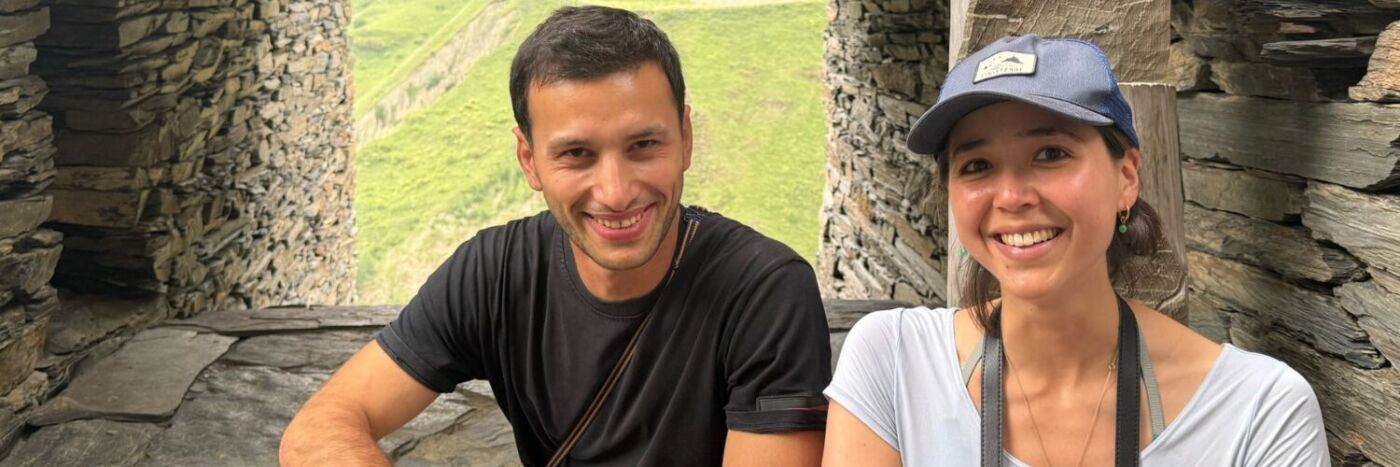
“Come to Georgia with curiosity. Our mountains are beautiful, but we want you to know our villages, taste our food, hear our stories and meet the people who live here too. Arrive as our guest and let us show you the Georgia we know and love.”
— Adventurous Ewe’s Georgia team
Svaneti or Tusheti & Khevsureti: which trek should I choose?
If you’re still deciding, I’d simplify it like this.
Choose Svaneti if…
You want challenging point-to-point mountain trekking combined with village life.
You like the idea of arriving at family-run guesthouses, eating home-cooked food, spending time within mountain communities and trekking amongst glaciers and medieval towers.
It’s still demanding mountain terrain, but you’re more closely connected with villages throughout the journey.
Choose Tusheti & Khevsureti if…
The words remote, wild and expedition make you want to know more.
You’re happy camping, want a stronger feeling of isolation and are drawn to the idea of crossing the mountains from one historic region into another rather than remaining within one valley system.
It’s the more expeditionary of the two trips.
And if you ask me which one I prefer?
I still couldn’t choose.
Having trekked them both, I think one actually helps you appreciate the other.
Svaneti helped me understand another side of Georgian mountain life after Tusheti.
And returning west after spending time in the east made me realise just how geographically and culturally varied this relatively small country is.
My advice before trekking in Georgia
Come prepared, but don’t over-plan how you expect Georgia to feel.
Mountain journeys rarely run precisely according to the version you’ve imagined at home.
Weather changes.
Trails get muddy.
A river may be higher than expected.
Lunch may be simpler than you’re used to.
Somebody may invite you somewhere you weren’t expecting to go.
A dog may decide you’re now walking together.
Your guide might start telling you a story that means you arrive somewhere slightly later than planned.
Allow some room for all of that.
Learn a few Georgian words.
Ask questions.
Try the food you don’t recognise.
Chat to the people you’re walking with.
Accept the toast. Many toasts.
Have a sip of cha cha.
And look beyond the big mountain views.
After trekking from the wild eastern Caucasus of Tusheti and Khevsureti to the ancient highlands of Svaneti in the west, I somehow feel more curious about Georgia than when I began.
And perhaps that’s what this country does particularly well.
You go for the mountains.
Then you discover how much more there is to come back for.
Sue Blunt